How to Separate a Shared Water Supply Pipe
A shared water supply can work unnoticed for years, until one property has low pressure, a leak appears beneath a driveway, or a sale exposes unclear responsibility. Knowing how to separate shared water supply arrangements gives each home or business a dedicated connection, clearer billing and better control over future repairs.
For many UK properties, particularly older terraces, converted buildings and former large homes split into flats, the original supply pipe was never designed for separate ownership. The practical solution is usually to install a new independent service pipe from the water company’s main to each property, then permanently disconnect the shared section where appropriate.
When does a shared supply need separating?
A shared supply is not automatically a problem, but it can become one when it causes responsibility, performance or compliance issues. If several properties are supplied through one communication pipe or private supply pipe, a leak may affect everyone while leaving neighbours uncertain about who should arrange and pay for the repair.
Low flow and pressure are another common trigger. Water demand is higher now than when many older supplies were installed. A narrow, ageing pipe serving two or more homes can struggle when showers, washing machines and boilers are used at the same time. Where the existing pipe is lead, replacement also provides an opportunity to remove a material many owners prefer not to retain in their drinking-water supply.
Separation is often considered before a property sale, a conversion into flats, major refurbishment or a new-build development within an existing plot. Landlords and commercial property managers may also need independent meters and shut-off points to manage tenants, occupiers and maintenance responsibilities properly.
Identify where the shared pipe runs
The first job is establishing the route and ownership of the existing supply. This is more involved than finding the internal stop tap. A supply may run from the water main in the highway, through a pavement, beneath a neighbour’s front garden, across a shared drive and into several buildings.
In broad terms, the local water company is responsible for its water main and commonly the communication pipe up to the boundary point. The property owner is usually responsible for the private supply pipe from that point onwards. The precise boundary can vary with the site layout, so it should be checked rather than assumed.
A specialist contractor can inspect visible pipework, trace the likely route and assess the condition of the supply. On more complex sites, trial holes, pipe tracing or leak detection may be needed. This early survey matters because the simplest-looking route is not always viable. Other utilities, trees, retaining walls, extensions and access restrictions can all affect where a new pipe can be installed.
It is also worth confirming exactly which properties are connected. In a row of terraces, the pipe serving your home may pass through adjoining land or supply a neighbouring property without either owner realising it. A clear plan prevents an unexpected loss of water when work begins.
How to separate a shared water supply
The usual process starts with an application to the local water company for a new connection or separate service. The water company will confirm its requirements, the proposed connection point and whether it will install the section from the public main. It may also set conditions for meters, pipe size, backflow protection and inspection before the new supply is connected.
Once the connection is agreed, the private pipework can be designed. Each property should have its own suitably sized pipe, internal stop tap and clear isolation point. Where metering is required, the meter position must remain accessible to the water company.
The new pipe is then installed between the boundary connection and the building. For a straightforward front garden, this may involve a narrow excavation. Where the route passes under driveways, paths, landscaped gardens or car parks, trenchless installation is often the better option.
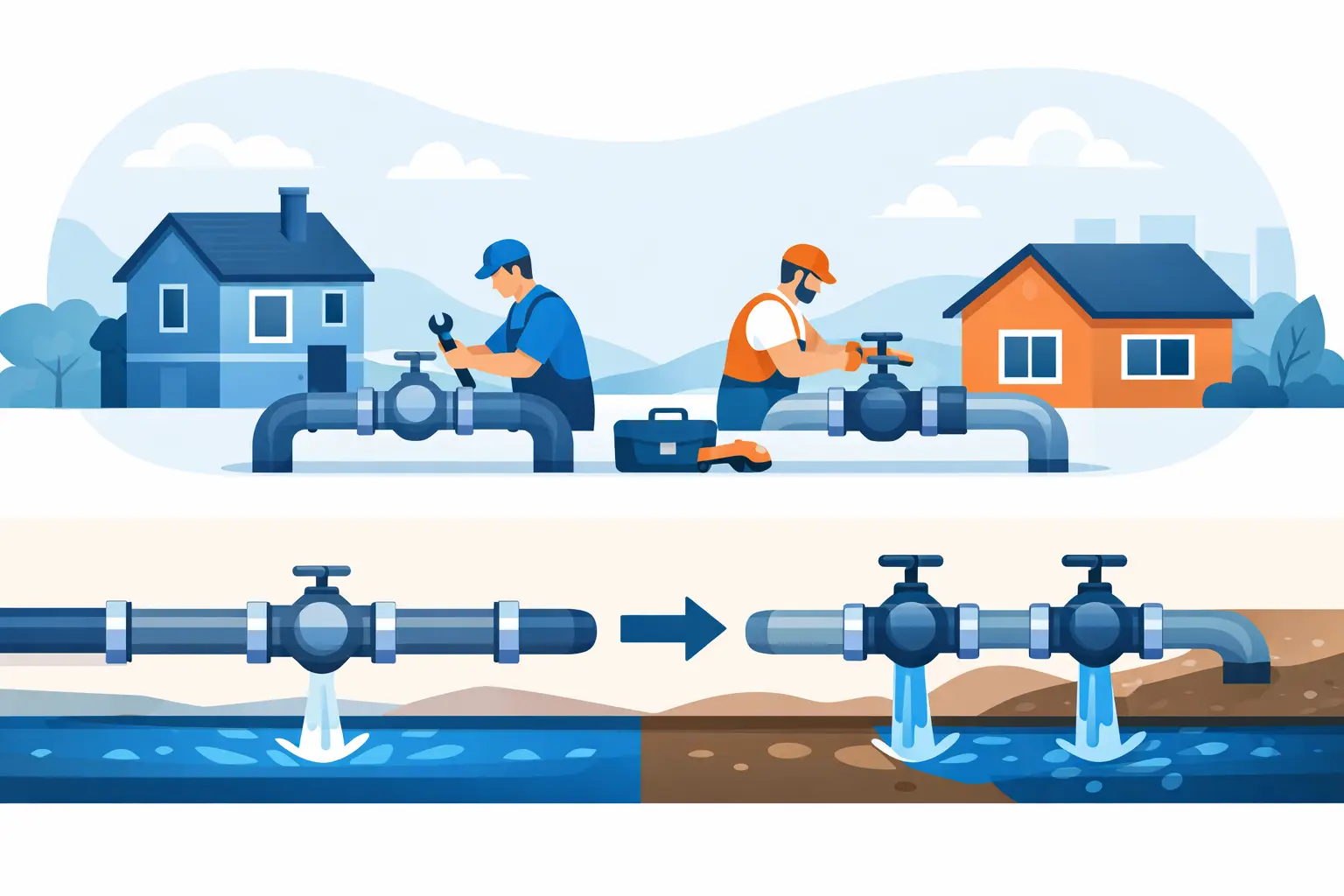
After installation, the pipe is pressure tested, flushed and connected into the property’s internal supply. The old shared pipe is then disconnected or capped in a controlled way, but only once it is confirmed that every affected property has a live independent supply. Reinstatement follows, with excavated areas, paving or surfaces returned as neatly as site conditions allow.
Water company approval and compliant installation
Do not arrange a private connection without involving the water company. Connecting to a public main, altering a boundary arrangement or commissioning a new supply requires approval from the relevant water undertaker. Work also needs to comply with the Water Supply (Water Fittings) Regulations.
Using an approved contractor helps keep the process straightforward. Contractors accredited through schemes such as WIAPS or Watersafe understand the standards expected for materials, fittings, notification and testing. For homeowners, that means fewer avoidable delays. For landlords, facilities teams and managing agents, it provides a clearer compliance trail for the project file.
Choosing the right installation method
Traditional excavation is sometimes the right choice. If the route is short, clear and easy to reinstate, open trenching can be a cost-effective method and gives direct access to the ground throughout the work.
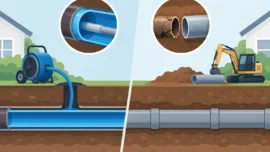
However, it is not the only option. Trenchless moling can create a route beneath lawns, driveways and paths with only small launch and reception holes. Horizontal directional drilling, often called HDD, can be suitable for longer or more technically demanding routes where accuracy and depth control are needed.
The benefit is practical: less digging, reduced spoil, quicker installation and less disturbance to finished surfaces. This can be particularly valuable where a property has block paving, tarmac, decorative landscaping or restricted access. It does depend on ground conditions and the presence of buried services, so a survey should determine whether no-dig installation is suitable rather than treating it as an automatic answer.
What can affect the cost?
There is no single price for separating a shared water supply because every site has different constraints. The main cost drivers are the distance from the water main to the property, the number of supplies being created, ground conditions, pipe diameter, traffic management requirements and the need to cross hard surfaces.
Water company charges for a new connection are separate from the private installation costs. Where a main extension, road opening or specialist traffic controls are required, the overall cost can increase significantly. Conversely, a short run in an accessible front garden may be comparatively straightforward.
It is sensible to obtain a written scope that distinguishes water company charges, excavation or trenchless work, pipe installation, testing and reinstatement. If several neighbours are separating from one shared line at the same time, a coordinated project can sometimes reduce disruption and avoid duplicated groundwork. Each owner’s legal and financial responsibility should still be agreed in writing before work starts.
Common problems to avoid
The biggest mistake is assuming the visible pipe route is the full story. Old supplies are often undocumented, and previous extensions, garages or garden alterations may conceal bends, joints and connections. Surveying first is cheaper than reopening a newly reinstated driveway.
Another issue is undersizing the new supply. A pipe should be selected for the property’s expected demand, not simply matched to an old pipe that may already be causing pressure problems. This is especially relevant for larger homes, properties with multiple bathrooms, flats and commercial premises.
Avoid leaving redundant shared pipework connected without a clear purpose. A poorly isolated section can create confusion during future leak investigations, while unused dead legs can be undesirable within a drinking-water system. The final arrangement should be labelled and explained to the owner, including the position of the stop tap and any external meter.
Finally, do not overlook access agreements. If the preferred route crosses neighbouring or shared land, written permission may be needed. The same applies to leasehold properties, managed estates and commercial sites where a freeholder, managing agent or facilities department controls the external areas.
A cleaner route to an independent supply
Separating a shared supply is a permanent property improvement, not simply a response to a current leak or billing dispute. It gives each occupier a clear supply route, helps protect water pressure and makes future repairs far easier to manage.
Watermains & Drains UK can assess the existing arrangement, plan a compliant replacement supply and use trenchless methods where they offer the least disruption. A site survey and clear quotation should come before any digging, so the final solution works for the property, the water company and everyone relying on the supply.