Stopcock Replacement Guide for UK Homes
When a stopcock will not turn, leaks around the spindle, or fails to shut the water off fully, it stops being a minor nuisance and becomes a property risk. This stopcock replacement guide explains what UK homeowners and landlords need to know before the problem turns into a leak, an emergency call-out, or water damage under the sink.
A faulty stopcock is easy to ignore until you actually need it. That might be during a burst pipe, a kitchen refit, a toilet repair, or a supply pipe leak investigation. If the valve seizes or starts dripping when touched, you can quickly end up with no reliable way to isolate the water entering the property.
What a stopcock does and why replacement matters
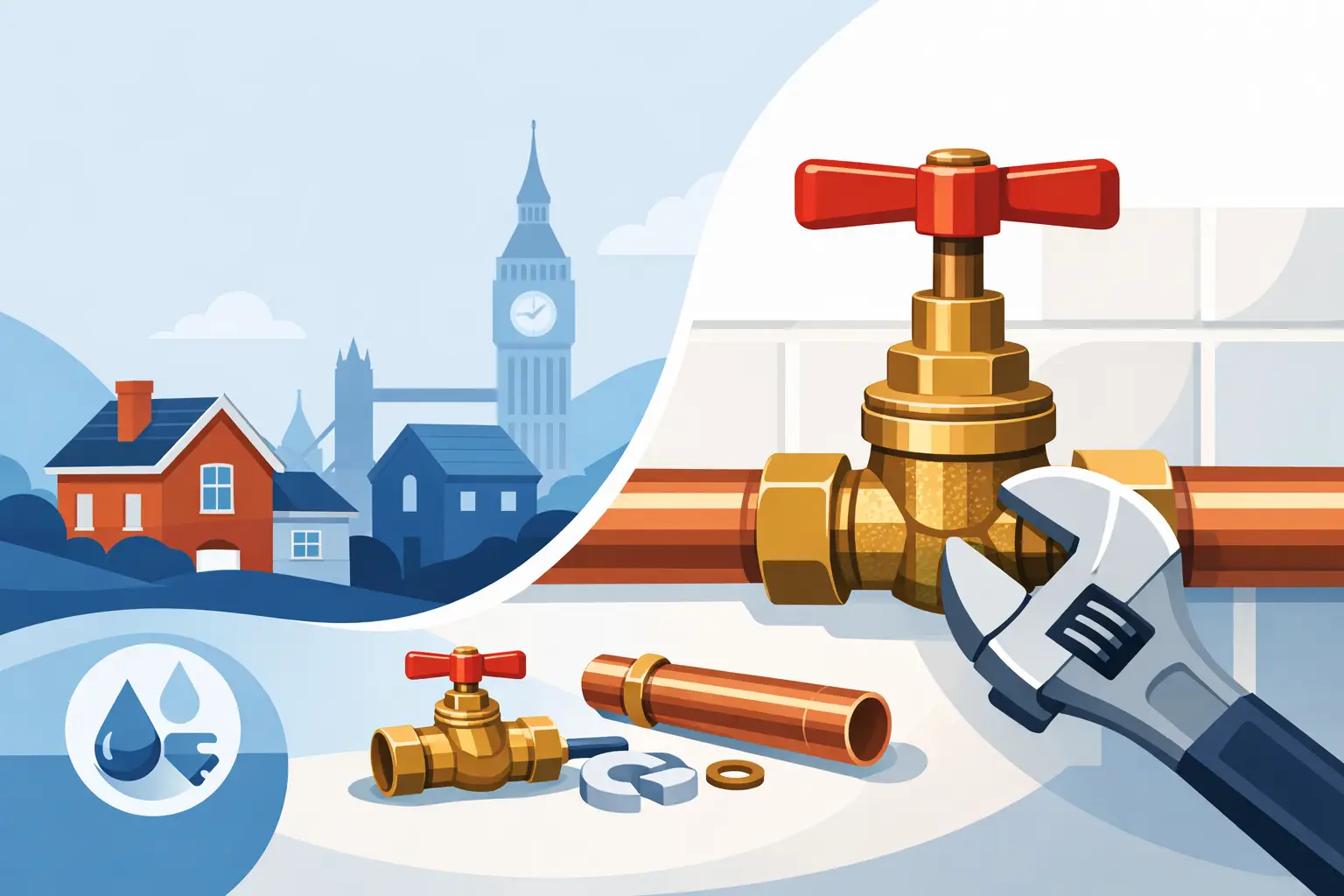
The internal stopcock is the main isolation valve for your water supply inside the property. In many homes it sits under the kitchen sink, though it can also be found in a utility room, cupboard, cellar, or near where the incoming mains pipe enters the building.
Its job is simple. Turn it clockwise and it should stop the incoming water supply. In practice, older stopcocks often become stiff through age, scale build-up, corrosion, or lack of use. Some will partly close but still allow water through. Others seem fine until they are operated, then begin leaking from the gland or body.
Replacement matters because an unreliable stopcock creates problems at the worst possible time. If you cannot isolate the water quickly, a relatively small leak can become a more disruptive repair. For landlords and commercial property managers, that can also mean tenant disruption, access issues, and avoidable reinstatement costs.
Signs you may need stopcock replacement
Some faults are obvious, while others show up gradually. If the stopcock is difficult to turn, very stiff, or fully seized, it is usually a sign the valve is at the end of its useful life. The same applies if it drips when operated, shows visible corrosion, or no longer shuts the water off completely.
Low confidence is also a valid reason to replace it. If you already know the valve is unreliable, any future plumbing work becomes more awkward. A straightforward job can suddenly require external isolation or more extensive intervention.
In older properties, replacement is often sensible during wider water supply work. If the incoming pipework is being upgraded, a leaking supply repaired, or old lead pipe replaced, fitting a modern, dependable internal stop tap at the same time is usually the cleanest option.
Stopcock replacement guide: what happens during the job
Every property is different, but the process is usually straightforward when access is good and the incoming pipe is in reasonable condition. The first step is identifying how the supply will be isolated before the old valve is removed. That may be at the external boundary stop tap, at a meter chamber, or by another approved isolation method.
Once the water is safely isolated, the old stopcock is removed and the surrounding pipework checked. This is where experience matters. Older internal pipework can be cramped, corroded, or made from materials that need careful handling. A rushed repair can disturb weakened pipe joints and create a larger problem than the original fault.
The new stopcock is then installed, the supply restored, and the valve tested under pressure. A proper job is not just about getting the water back on. It should leave you with a valve that operates smoothly, isolates fully, and is positioned for sensible future access.
If the existing layout is poor, minor alterations may be worth making. For example, if the stopcock is buried behind cabinets or fitted in an awkward corner, repositioning it slightly can save time and stress later.
When it is a simple swap – and when it is not
The simplest replacement is like-for-like on accessible copper pipework with a working external isolation point. In that situation, the work is often quick and contained.
It becomes more involved if the external stop tap is also faulty, buried, or shared, or if the incoming supply pipe is in poor condition. Galvanised steel, ageing lead, heavily scaled pipe, or cramped under-floor entries can all complicate what sounds like a basic valve change.
There is also the issue of responsibility. The internal stopcock is usually on the property side, but the wider arrangement may involve communication pipes, meter chambers, or boundary fittings that need a compliant approach. If the fault is part of a bigger supply issue rather than just the valve itself, replacing the stopcock alone may not solve the underlying problem.
That is why a site-specific assessment is often the sensible route, especially in older homes and rented properties.
Can you replace a stopcock yourself?
Some householders are comfortable with basic plumbing, but stopcock replacement is one of those jobs where the risk is often underestimated. The main challenge is not usually removing the old valve. It is making sure the water is properly isolated, the pipework is sound enough to work on, and the new installation remains watertight under pressure.
If anything goes wrong, the result is not a slow waste-pipe drip. It is mains water inside the property. That can damage cupboards, flooring, plaster, and decorations very quickly.
For that reason, DIY replacement is rarely the best option when the valve is seized, the surrounding pipework is old, or the external isolation point is unreliable. Landlords and commercial clients in particular tend to prefer a contractor-led repair because the priority is a safe, documented outcome with minimal disruption.
Costs, disruption, and what affects the price
There is no single fixed cost for stopcock replacement because the final price depends on access, pipe material, valve location, and whether isolation is straightforward. A simple indoor replacement is one thing. A job involving a failed outside stop tap, restricted access, or deteriorated incoming pipework is another.
Properties with older supply arrangements can need additional work. If the stopcock issue is tied to a leaking or obsolete incoming main, it may be more cost effective to deal with both at once rather than paying for separate visits and repeated disruption.
The good news is that, when handled properly, disruption is usually limited. Clean working, sensible isolation planning, and tidy reinstatement matter just as much as the fitting itself. For most customers, the real value is not just the valve. It is having the water supply made safe without turning a small repair into a messy one.
Why specialist contractors are often the better fit
A stopcock sits at the point where internal plumbing meets the incoming supply, which is why the job can move beyond general plumbing very quickly. If there are complications with the mains entry, supply pipe condition, or external isolation, it helps to have a contractor who works with water infrastructure regularly rather than treating it as a one-off domestic repair.
That is particularly relevant where lead supply pipes, shared supplies, hidden leaks, or reinstatement-sensitive surfaces are involved. In those cases, the right solution may not be a simple valve change. It may be a broader supply upgrade using modern methods to keep disruption down.
For homeowners and landlords across the North West, that practical, least-disruption approach is often what makes the difference between a quick fix and a properly resolved problem. Watermains & Drains UK works in that space, combining supply pipe expertise with accredited, insured delivery and methods designed to avoid unnecessary excavation where wider work is needed.
A stopcock replacement guide for older properties
Older housing stock deserves a separate mention because stopcock problems are often a symptom rather than the full issue. If a property still has lead pipework or a very old incoming supply, the internal valve may be only one weak point in a system that is already overdue for renewal.
In that situation, replacing the stopcock can still be worthwhile, but it should be done with an eye on the bigger picture. If further supply work is likely within the next year or two, it makes sense to plan around that rather than treating each fault in isolation.
The same applies to repeated low pressure, unexplained damp near the mains entry, or discoloured water after maintenance. Those signs do not always point to the stopcock itself. They can indicate a wider issue with the supply arrangement that needs proper investigation.
Choosing the right next step
If your stopcock is leaking, seized, or no longer isolates the water fully, do not wait until you need it in a hurry. A quick assessment now is usually far easier than dealing with a failure during a leak or urgent repair.
The right next step depends on the condition of the valve, the age of the pipework, and how easy it is to isolate the supply safely. Sometimes that means a straightforward replacement. Sometimes it points to wider supply work that will save time, money, and disruption in the long run.
A dependable stopcock is one of those small details that only gets noticed when it fails. Getting it sorted properly gives you something better than a new valve – it gives you control when it matters most.