

How to Prepare a Driveway for Moling Works
A new water supply does not always mean a long trench across your frontage. To prepare a driveway for moling works properly, the priority is giving the installation team safe access, clear information about buried services and suitable points for the small launch and reception excavations. A little preparation helps protect the surface you have paid for and keeps the work moving without avoidable delays.
Moling is a trenchless method used to install or replace pipes beneath driveways, paths and gardens. A pneumatic soil displacement mole creates a bore underground, allowing a new water pipe to be drawn through with far less excavation than traditional digging. It is often the practical choice for lead pipe replacement and new water supply installations, but every driveway and ground condition needs assessing on its own merits.
What moling work involves beneath a driveway
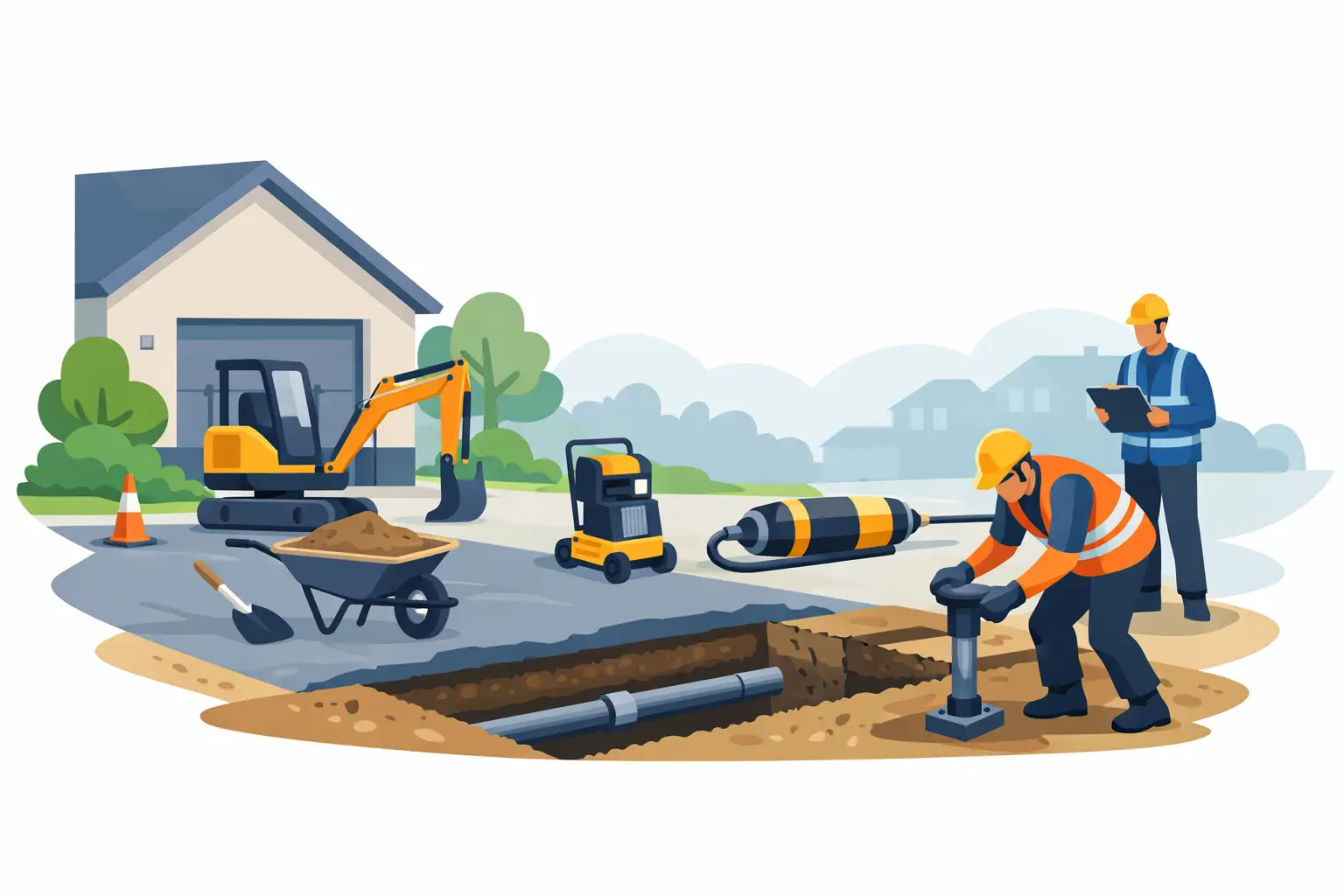
A moling installation is not completely excavation-free. Small pits are normally needed at each end of the planned route: one to launch the mole and another to receive it, connect the new pipe or make the final connection. These are usually positioned where they cause the least disruption, such as near the property boundary, by an external stop tap, or at the point where the supply enters the building.
The contractor will plan the route around known obstacles and existing services. The aim is to retain as much of the driveway as possible, rather than lifting blocks, breaking concrete or cutting a wide channel through tarmac. Once the pipe is installed and tested, the working areas are reinstated to an agreed standard.
This approach can be fast and cost effective, especially where a driveway is sound, recently laid or difficult to match after excavation. However, moling may not be suitable in every location. Very shallow services, dense obstructions, unstable ground, substantial tree roots or an unknown underground layout can change the recommended method. A professional site survey is the right place to establish this.
Prepare your driveway for moling works before the survey
The first useful step is to make the driveway accessible. Move cars, vans, bins, trailers, planters and any loose furniture away from the proposed work area before the team arrives. Contractors need room for equipment, spoil handling and safe movement between the property boundary and the house.
If you have a gate, narrow access or a shared entrance, mention it when arranging the survey. Access restrictions do not necessarily prevent trenchless installation, but they can affect plant choice, scheduling and the location of the launch pits. For landlords and commercial property managers, it is also sensible to notify tenants, caretakers or site staff so that vehicles are not parked over the planned route on the day.
Take note of features fixed into or close to the driveway. This includes drainage channels, inspection chambers, boundary posts, lighting cables, EV charger supplies, irrigation lines, security gates and decorative edging. Do not assume a cable or pipe follows a straight line simply because its surface fitting is visible. Tell the surveyor about anything you know, even if you are unsure whether it remains in use.
Find out where existing services run
The main risk around any underground work is an unrecorded or poorly located service. Water, gas, electricity, telecommunications, drainage and private lighting supplies may cross the driveway at different depths. Older properties can be particularly unpredictable, especially where extensions, previous repairs or driveway resurfacing have taken place over several decades.
Provide any plans, photographs from earlier building work, invoices or utility correspondence you have available. These documents are not a substitute for site checks, but they can help form a clearer picture. A competent contractor will use appropriate service detection and safe working procedures before deciding on the route and depth of the mole.
Be particularly clear about private services. For example, a supply feeding a garage, garden office, outbuilding or electric gate may not appear on standard utility records. If there is a septic tank, private drainage run, soakaway or oil line nearby, this should be identified during the survey as well.
Check the condition and construction of the surface
Driveways are built in different ways, and the finish affects how work should be planned and reinstated. Block paving can often be carefully lifted and relaid around a small excavation, provided matching blocks and a stable sub-base are available. Tarmac usually requires a tidy cut and repair, while concrete may need a more visible local reinstatement depending on its thickness, reinforcement and condition.
Resin-bound surfaces, printed concrete and older decorative paving deserve extra discussion. A small repair may be technically sound but still show because weathering and colour variation make an exact match difficult. If appearance is a major concern, raise this before work starts so the contractor can explain the likely finish and agree the most discreet pit locations.
Existing cracks, loose blocks, sinking areas and poor drainage should also be recorded before installation. Photographs taken before work begins are useful for everyone. They create a clear baseline and prevent pre-existing defects being confused with later issues.
Make practical arrangements for installation day
Moling teams need a clear route from their vehicle to the working area. Keep the driveway and nearby pavement free of obstructions where possible, and ensure any required access to the property, external stop tap or meter position has been arranged. If you will not be present, provide a named contact who can answer questions promptly.
For a new water supply or lead pipe replacement, there may be a planned interruption to your water supply while connections are completed. The exact timing depends on the work scope and the requirements of the local water company. Fill a few containers for drinking water and postpone activities that rely heavily on water, such as running a washing machine or hosting trades who need a supply.
Pets should be kept safely away from the work area, and children should not be allowed near excavations, equipment or pipe materials. The team will establish a safe work zone, but clear household arrangements make the day easier and safer.
If parking on the street is limited, reserve alternative space for your vehicles in advance. For properties with shared driveways, speak with neighbours early. Their cooperation may be needed for access, temporary parking or permission to work close to a boundary. Where a communal or managed area is involved, obtain approval from the freeholder, managing agent or relevant facilities contact before dates are fixed.
Questions worth asking before work starts
A clear scope prevents surprises. Ask where the launch and reception pits are expected to be, how deep the new pipe will run and what type of pipe will be installed. You should also understand which part of the supply is private and which part is the water company’s responsibility, particularly if the work involves a connection at the boundary.
Confirm how the driveway will be protected during the job and how reinstatement will be handled. The answer should be specific to your surface, not a vague assurance that it will be put back later. It is reasonable to ask whether matching materials are needed, whether any settlement period is expected and who will deal with any required final surface repair.
For landlords, managing agents and commercial sites, request the documentation appropriate to the work: insurance details, risk assessments, method statements and evidence of relevant approvals. Watermains & Drains UK is WIAPS and Watersafe approved, carries £10 million public liability insurance and provides long-term workmanship assurance, giving property owners a clear route to a compliant, accountable installation.
When moling may need a different plan
The least disruptive method is not always the right method. A survey may reveal that there is insufficient room to launch the mole, that buried services make the route unsuitable or that the pipe needs to pass through ground that cannot be displaced safely. In those circumstances, a short section of conventional excavation, an alternative route, or horizontal directional drilling may be recommended.
That is not a failure of the process. It is the contractor making a decision based on the actual site rather than forcing a preferred method. The best outcome is a reliable, correctly installed supply pipe with sensible reinstatement, not simply the smallest possible hole in the ground.
Good preparation gives your contractor the information and access needed to make that decision early. Clear the space, share what you know about the property and ask for the route and reinstatement plan to be explained before work begins. That is the simplest way to protect your driveway while getting a new water supply installed with the least disruption possible.


