

HDD Utility Crossing Project Example Explained
When a new water supply or drainage run needs to pass beneath a road, car park, access route or landscaped area, open-cut excavation is often the option people picture first. In practice, a well-planned HDD utility crossing project example usually shows why trenchless installation is the better fit – less surface damage, fewer traffic issues and a cleaner handover for the property owner or site manager.
For homeowners, landlords and facilities teams, the value is simple. You still need the pipe or duct installed safely and correctly, but you do not want a front drive dug up, a business entrance shut for days, or a freshly finished surface reinstated at extra cost. Horizontal directional drilling, often shortened to HDD, is designed for exactly that sort of crossing.
What an HDD utility crossing project example looks like
A typical project starts with a property or site that needs a new service connection on the far side of an obstacle. That obstacle might be a highway, a private road, a yard, a hardstanding area, a watercourse buffer, or an area where excavation would create unnecessary disruption.
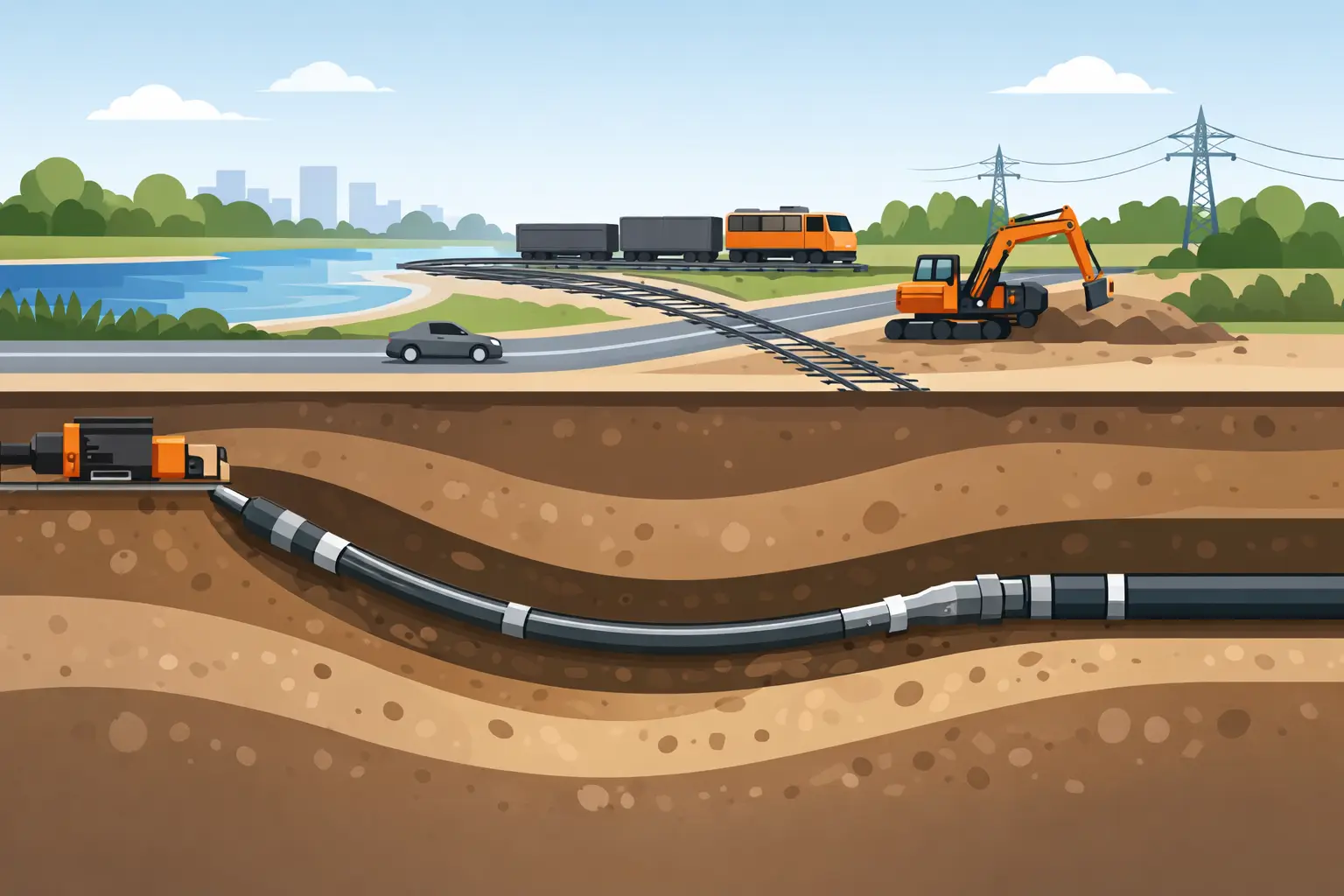
Imagine a commercial unit that needs a new water main from the public supply side of the carriageway into its service yard. Digging across the road would mean permits, traffic management, reinstatement and a longer programme. An HDD crossing allows the contractor to launch from one side, drill beneath the obstruction at the required depth, and install the new pipe with minimal disturbance above ground.
That same approach also suits residential work. If a homeowner needs a replacement supply pipe beneath a driveway, mature garden or access path, trenchless drilling can avoid the cost and mess of opening the entire route.
Why HDD is chosen over open excavation
The main reason is disruption. Excavation-led work can be perfectly suitable on some jobs, but it becomes less attractive when surfaces are expensive to reinstate or when access must be kept open. Block paving, tarmac drives, business forecourts and adopted highways all add cost and complexity once you start breaking ground.
An HDD crossing reduces the footprint of the work to launch and exit pits, along with any connection excavations. That often means a tidier site, a shorter programme and less inconvenience for residents, customers or tenants. It can also reduce exposure to complaints where pedestrian or vehicle access is sensitive.
That said, HDD is not the answer to every crossing. Ground conditions, depth requirements, existing buried services and the size of the product pipe all affect suitability. On some sites, a short open-cut trench may still be the more practical choice. A competent contractor will assess both methods rather than force a trenchless solution where it does not fit.
The planning stage matters most
In most successful HDD projects, the real work starts before the drill rig arrives. A proper site review is what separates a controlled installation from a difficult one.
First, the contractor establishes the route, entry point and exit point. This sounds straightforward, but the line of the drill must account for existing services, required cover levels, connection positions and the bend radius of the drill path. A route that looks direct on paper may not be practical once all constraints are considered.
Service information is then checked. Utility drawings, site records and, where needed, on-site detection all help reduce risk. This is especially important on older properties and developed commercial sites where records are incomplete or services have been altered over time.
Ground conditions also need attention. Clay, mixed ground and made ground all behave differently during drilling. Some soils are favourable; others increase the chance of deviation, collapse or fluid loss. This affects tooling choice, drilling fluid use and the overall method statement.
For a water pipe crossing, product selection matters as well. The installed pipe must suit the application, pressure rating and connection detail. There is no value in a neat trenchless crossing if the pipe material or connection arrangement is wrong for the utility being installed.
A step-by-step HDD utility crossing project example
Take a site where a landlord needs a new 63mm water supply to a building across a busy entrance road. The goal is to avoid closing access and to protect recently laid tarmac.
The job begins with a site survey, route marking and a review of utility records. Trial holes may be used at key points to confirm the position of known services before drilling starts. Once the line is agreed, the team prepares a launch pit on one side and an exit pit on the other.
The pilot bore is then drilled first. This is the guidance stage, where the operative follows the planned alignment beneath the road at the target depth. Accuracy matters here because the pilot path controls everything that follows.
Once the pilot bore breaks through at the exit pit, the route is checked and prepared for enlargement. Depending on the pipe size and ground, the bore may be reamed to create enough space for the product pipe. On smaller jobs, this can be relatively straightforward. On larger crossings or more difficult ground, the process may need more than one pass.
The new pipe is then attached and pulled back through the bore. Pullback must be controlled to avoid damage to the pipe and to maintain the integrity of the installation. After that, the contractor completes the final connections, pressure tests where required, and reinstates the limited excavation areas.
From the client’s point of view, the visible difference is obvious. Instead of a full-width trench through the road or yard, there are only localised work areas and a much cleaner finish.
Risks and trade-offs in HDD crossing work
A realistic HDD utility crossing project example should include the risks, because trenchless work is highly effective but not magic.
The first risk is striking existing services. Good records help, but records alone are never enough. Verification on site is often needed, especially around properties with a long service history.
The second is ground uncertainty. If the material changes unexpectedly, progress can slow and the bore may become harder to control. In some cases, the contractor may need to revise the method or, rarely, stop and reassess the route altogether.
The third is space. HDD rigs, pits and pipe stringing need room. On tight urban plots, the drilling method may still be possible, but logistics become a bigger part of the job. A no-dig solution is not automatically a no-space solution.
There is also a cost trade-off. HDD can save money when reinstatement and disruption costs are high, but for a very short, simple crossing in easy ground, open excavation may come out cheaper. The right method depends on the full picture, not one headline figure.
What property owners and site managers should ask
If you are reviewing a proposed crossing, ask how the route has been checked for existing utilities, what ground conditions are expected, what pipe material is being installed and what reinstatement is included. Those points tell you a lot about whether the quote reflects proper planning or just a headline price.
It is also sensible to ask about approvals, insurance and workmanship cover. For water infrastructure in particular, accreditation-backed contractors offer a clearer level of assurance on compliance and handover standards. That matters whether the work is at a house in Greater Manchester or on a managed commercial site where records and accountability are essential.
A specialist contractor should also be able to explain the practical outcome in plain language. How long will the crossing take? Will access be maintained? What will be visible once the job is complete? Those are the questions most clients really care about.
Why specialist delivery makes the difference
HDD works best when it is treated as a specialist utility installation method, not as an add-on to general groundworks. The equipment is only part of it. Route design, service avoidance, pit positioning, pipe handling and final connections all need to be managed properly for the project to go smoothly.
That is why many clients prefer a contractor that can handle the full scope – survey, trenchless installation, connection and reinstatement – rather than splitting responsibility across several parties. It shortens communication lines and tends to produce a cleaner result on site.
For companies such as Watermains & Drains UK, that approach fits the jobs clients ask for most often: new water supplies, lead pipe replacements, drainage runs and utility crossings where speed and minimal disruption matter just as much as technical compliance.
If you are considering a crossing beneath a road, driveway or hardstanding, the best starting point is not the machine. It is a clear site assessment and an honest view of whether HDD is the right method for that ground, that route and that property.





