

Moling vs Trenching for Driveways
A driveway is often the point where a simple underground job starts to feel expensive. Once paving, concrete or tarmac is involved, the real question becomes less about the pipe itself and more about how you get to it. That is why moling vs trenching for driveways matters so much for homeowners, landlords and site managers trying to protect surfaces, keep access open and avoid unnecessary reinstatement costs.
If you need a new water supply pipe, a lead pipe replacement or another underground service run beneath a driveway, there are usually two broad options. One is trenching, which means excavating a continuous channel from one point to another. The other is moling, a trenchless method that installs pipework underground with only small launch and reception pits. Both are proven methods. The right one depends on the ground conditions, the route, the depth and what sits above it.
Moling vs trenching for driveways: the core difference
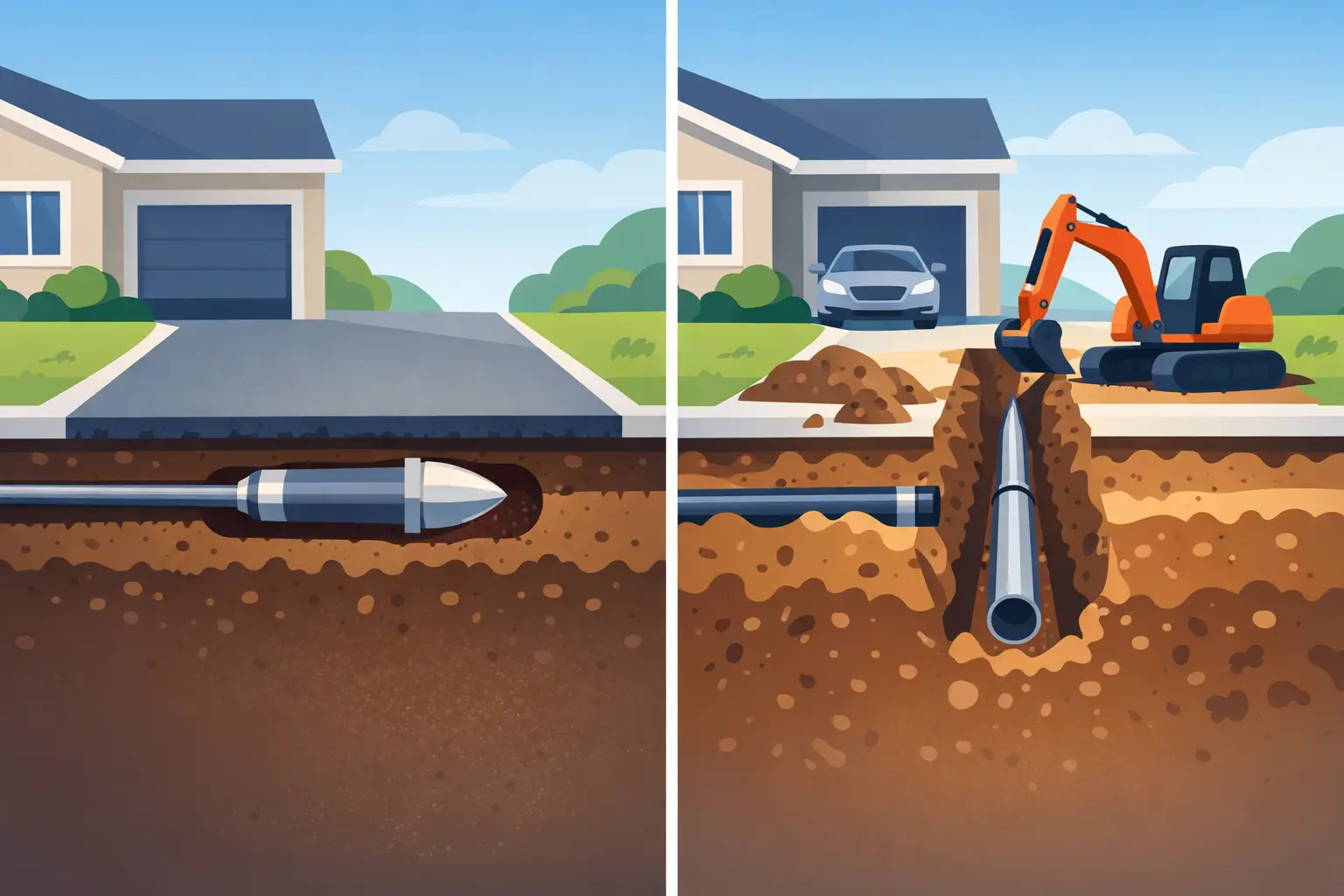
Trenching is the traditional excavation method. Contractors break out the driveway surface, dig down along the required line, install or expose the pipe, then backfill and reinstate the area. It gives full visibility of the trench throughout the job, which can be useful when there are several services to navigate or when repairs are extensive.
Moling is different. A pneumatic mole travels underground between two small excavations, creating a bore for the new pipe without opening the full surface. In practical terms, that usually means far less mess on site, less spoil to remove and much less reinstatement afterwards. For many domestic driveways, that is the main advantage.
The choice is not just about convenience. It affects timescale, surface repair, cost structure and the level of disruption to a property.
Why moling is often preferred under driveways
Driveways are one of the clearest cases for trenchless work because surface reinstatement can quickly become the biggest part of the job. Block paving may need careful lifting and relaying. Patterned concrete is difficult to patch invisibly. Resin and decorative finishes can be even less forgiving. Once a long trench is cut through a finished driveway, there is always a reinstatement question, even when the underground work itself is straightforward.
Moling reduces that problem because the surface usually stays largely intact. Instead of opening the whole route, the contractor works from smaller excavations at each end. That tends to mean faster completion, cleaner sites and less disturbance to vehicles, front gardens and entranceways.
For homeowners, the benefit is obvious: you keep more of the driveway untouched. For landlords and commercial sites, it can also mean less inconvenience for tenants, staff or visitors. Where access matters, that reduction in disruption is often worth more than the excavation method alone.
When trenching still makes sense
Moling is not automatically the better option in every case. Good contractors will say that clearly, because the ground and the route decide what is practical.
Trenching can be the better choice where the ground is unsuitable for a mole, where there are too many unknown services in the line of the proposed bore, or where the job involves a repair rather than a new installation route. If a damaged drain has collapsed directly beneath part of a driveway and the defect needs open access, excavation may be the most reliable method.
It can also make sense where the driveway is already due for replacement, or where the route is short and the reinstatement is simple. In those cases, the savings from trenchless work may be less significant.
The key point is that trenching gives direct visual access for the full length of the excavation. That can be an advantage on complex sites, even if it is more disruptive.
Cost is not just about the digging
People often ask which is cheaper, but moling vs trenching for driveways is not a simple price-per-metre comparison. The excavation method is only one part of the total job cost.
With trenching, the initial digging can appear straightforward, but the final cost may rise once spoil removal, waste handling, driveway breaking out, reinstatement materials and labour are factored in. If the surface is specialist or if matching the finish is difficult, reinstatement can become a major expense.
Moling can sometimes carry a higher specialist installation cost, but it often avoids much of that surface repair. On a finished driveway, that can make the overall project more cost effective. It also reduces the hidden cost of inconvenience – blocked parking, restricted access and the time spent putting surfaces back into acceptable condition.
This is why proper site assessment matters. A method that looks cheaper at first glance is not always the one that leaves the property in the best position once the work is complete.
Ground conditions and access decide a lot
No-dig methods are highly effective, but they are still dependent on site conditions. Very rocky ground, unstable material or heavily congested underground routes can make moling less suitable. The same goes for sites where launch and reception pits cannot be formed safely.
Access is another practical factor. On some properties there is enough room to set up for trenchless installation without difficulty. On others, walls, steps, service boxes or tight boundaries limit what can be done. A contractor needs to assess not only whether the pipe can be installed, but whether the site can be worked safely and tidily.
Depth matters too. A new water supply pipe must be laid at an appropriate depth, and the route needs to avoid existing services. On driveways with known utility congestion, trenching may sometimes be chosen simply because the route needs close control at every stage.
What this means for new water supply pipes
For domestic water supply upgrades, moling is often the preferred method under driveways. That is especially true where an old lead supply pipe is being replaced from the boundary to the house. In many of these projects, the aim is clear: install a compliant new pipe quickly, protect the property and keep reinstatement to a minimum.
That is where specialist trenchless contractors offer a clear advantage. They are set up to assess the route properly, use modern equipment and complete the installation with less disruption than a general excavation-led approach. For customers, the result is simple – the pipe gets replaced without turning the front of the property into a building site.
Companies such as Watermains & Drains UK are often brought in for exactly this reason. The value is not just the mole itself. It is the combination of approved installation standards, professional reinstatement planning and the ability to complete the work with minimal disruption.
How to choose the right method
The best decision usually comes from a site survey, not from guessing based on one factor like cost. A good contractor will look at the driveway construction, the distance of the run, the likely ground conditions, the position of existing services and the final reinstatement implications.
If the surface is expensive to repair, the route is relatively direct and the ground is suitable, moling is often the stronger option. If the area is congested, the repair requires full exposure or the surface is already being removed, trenching may be the more sensible route.
What matters most is that the method fits the job. The wrong approach can create avoidable cost, delay and disruption. The right one gets the service installed or repaired with the least practical impact on the property.
The question to ask before any driveway excavation
Before agreeing to any underground work across a driveway, ask not just how the pipe will be installed, but how the driveway will look and function afterwards. That is usually where the difference between a basic quote and a specialist solution becomes obvious.
For many properties, moling offers the cleaner and less disruptive answer. For others, trenching is still the correct and more controlled method. A dependable contractor should be able to explain why, back it up with experience and set out a clear plan for both the underground work and the finish above ground.
When that happens, you are not simply choosing between two techniques. You are choosing the method that protects access, controls reinstatement and gets the job done properly the first time.





