Sewage Treatment Tank Installation Guide
A failed septic setup usually does not give much warning. You start with slow drains, wet ground near the tank, bad smells after rain, or an Environment Agency concern when a sale or renovation is under way. In those situations, sewage treatment tank installation is not just another groundworks job. It needs the right design, the right fall on the pipework, the right discharge point, and a contractor who can complete the work without turning the whole garden or access road into a building site.
For homeowners, landlords and site managers, the main question is simple: what does a proper installation involve, and how do you avoid paying twice because something was missed first time?
What sewage treatment tank installation actually involves
A sewage treatment tank is different from a basic septic tank. Rather than only separating solids, it treats wastewater to a much higher standard before discharge, usually to a watercourse or drainage field depending on the site and the permissions in place. That makes it a better fit for many rural and semi-rural properties, replacement projects, and sites where older systems no longer meet current expectations.
The installation itself is not just about dropping a tank into a hole. A proper job starts with assessing the existing drainage layout, the property’s daily load, access for plant, soil conditions, groundwater levels and discharge options. Pipe runs, invert depths, ventilation, electrical supply for the treatment unit, alarms where required, and reinstatement all need to be considered from the start.
Where that early planning is weak, the problems show up later. Tanks can sit too high or too low, outlets can fail to achieve correct falls, and drainage fields can be installed in unsuitable ground. Those are expensive mistakes because they usually mean returning to excavate again.
When a sewage treatment tank is the right choice
In practical terms, a treatment tank is often the right answer when an old septic tank is underperforming, when discharge rules make a direct outlet unsuitable, or when a property is being upgraded and the existing foul drainage arrangement cannot cope. It can also make sense during major refurbishments, extensions, barn conversions and new-build work where a mains connection is not available or would be disproportionately costly.
There is always a balance between upfront cost and long-term reliability. A cheaper system on paper can become the more expensive option if it needs regular call-outs, creates drainage complaints, or causes issues when the property is sold. Buyers, surveyors and insurers tend to look more closely at private drainage now than they once did.
Site conditions matter more than most people expect
Every installation depends on the ground. Clay-heavy sites, high water tables, restricted access and sloping gardens all change the method and the programme. A level plot with clear machinery access is one thing. A rear garden behind a terraced property, or a commercial site where access must stay open, is another.
This is where specialist drainage contractors stand apart from general builders. The tank size and type are only part of the picture. The excavation support, spoil handling, backfill specification, pipework alignment and final reinstatement often determine whether the job runs smoothly.
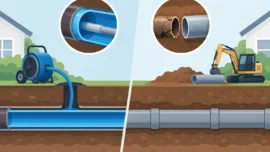
If the installation is near driveways, paving or landscaped areas, minimising disruption becomes a serious part of the plan, not a nice extra. In some cases, trenchless methods can reduce excavation on connecting runs, especially where long pipe routes cross finished surfaces. That does not remove the need for excavation at the tank position itself, but it can reduce the footprint of the overall works.
Regulations, consents and compliance
Sewage treatment tank installation in the UK must be approached with compliance in mind. Requirements vary by site, discharge method and local conditions, but the broad principle is straightforward: the system must be suitable for the property and installed in line with current rules.
That usually means checking building control requirements, discharge arrangements and whether any environmental permissions or exemptions apply. Distances from buildings, boundaries, watercourses and boreholes also matter. So does safe access for maintenance and emptying.
For landlords and commercial property managers, there is an added layer of risk. A non-compliant system can lead to tenant complaints, operational disruption and awkward questions during refinance, sale, or insurance discussions. For that reason, it pays to use contractors who are used to documented processes, clear scopes and professional handover information.
The main stages of sewage treatment tank installation
The best installations follow a clear sequence. First comes the site assessment and design check, then setting out and confirming levels. After that, the excavation is carried out, the base is prepared, the tank is placed and connected, and the discharge arrangement is installed. The system is then tested, commissioned and backfilled correctly before the site is reinstated.
None of that is glamorous, but each stage matters. The base needs to be right for the tank and ground conditions. Connections need to be watertight and correctly aligned. Electrical components need safe installation. Most importantly, the finished system needs to work in normal day-to-day use, not just look tidy on completion.
A contractor who rushes through the levels or skips proper testing may still leave a neat lawn behind. That does not help much if toilets back up two months later.
Replacing an old tank versus installing from new
Replacement work is often more awkward than a new installation because the existing drainage may be poorly mapped, partially collapsed or altered over time. Old tanks are not always where owners think they are, and incoming pipework can be shallower or deeper than expected.
New installations are usually more straightforward from a design point of view, but they still need careful planning around access, falls and discharge. On occupied sites, the challenge is often maintaining usable foul drainage for as much of the programme as possible and keeping the working area safe and tidy.
Cost depends on more than the tank itself
One of the most common misunderstandings is assuming the tank unit is the bulk of the cost. In reality, sewage treatment tank installation pricing is shaped by excavation depth, spoil removal, access restrictions, length of pipe runs, power supply requirements, discharge arrangements and reinstatement.
A straightforward install with good access and simple ground conditions will usually be more cost effective than a technically difficult site, even if the same tank model is used. If a contractor has to protect nearby structures, manage groundwater, work around existing services or carry materials through restricted access, the labour and programme increase quickly.
The cheapest quote is not always the most economical. If reinstatement is vague, disposal is excluded, or commissioning is not clearly stated, the final bill can move around after work starts. Clear quoting matters because it gives property owners a realistic picture from the start.
Choosing the right contractor
This type of work sits between drainage, civils and compliance. That is why experience matters. You need a contractor who understands underground services, site levels, drainage performance and the practical realities of working on lived-in or operational properties.
Look for evidence of proper insurance, relevant approvals where applicable, and a track record of tidy completion. Communication also matters more than people think. A good contractor explains what will be excavated, how long the foul drainage will be interrupted, what access is needed, and what the finished site will look like.
For customers across the North West, especially where access is tight or disruption is a concern, that specialist approach makes a noticeable difference. Contractors such as Watermains & Drains UK are used to planning infrastructure work with minimal mess, clear scheduling and proper reinstatement, which is exactly what most property owners want when drainage problems need fixing without dragging on for weeks.
Common problems that can be avoided
Most failures are not mysterious. They usually come back to poor siting, poor levels, incorrect backfilling, unsuitable discharge arrangements or undersized systems. Sometimes the tank is fine but the drainage field is not. Sometimes the drainage field is serviceable but the incoming pipework has not been laid properly.
Another common issue is underestimating future demand. A system that just about copes now may struggle after an extension, occupancy increase or use change. Planning for realistic usage gives better long-term value than installing to the bare minimum.
How long does installation take?
It depends on the site, but many domestic projects are completed over several days rather than several weeks. Straightforward jobs with clear access move faster. Complicated excavations, poor weather, difficult ground or extensive reinstatement can extend the programme.
The important point is not simply speed. It is controlled delivery. Fast is useful only if the levels are right, the site is left safe and the system performs as it should.
A well-installed treatment tank should quietly do its job for years. That is the outcome worth paying for – a compliant, dependable system, a tidy finish, and no need to revisit the same ground again six months later.