

Best Trenchless Installation Methods for UK Homes
A new water supply should not automatically mean a trench cut through your driveway, lawn or paving. The best trenchless installation methods can install or replace underground pipework through small access points, keeping disruption, reinstatement and time on site to a minimum. For homeowners, landlords and property managers, that can make the difference between a straightforward upgrade and a costly mess.
The right method depends on the pipe route, ground conditions, depth, access and the services already beneath the property. A specialist contractor should assess these factors before promising a no-dig solution. Trenchless work is highly effective, but it is not a one-size-fits-all answer.
What makes a trenchless method the best choice?
Traditional excavation still has a place where ground is obstructed, pipe routes are unclear or a large chamber needs to be built. However, opening a long trench can mean lifting block paving, damaging established landscaping and creating significant reinstatement work. It can also affect access to homes, tenants, customers and vehicles.
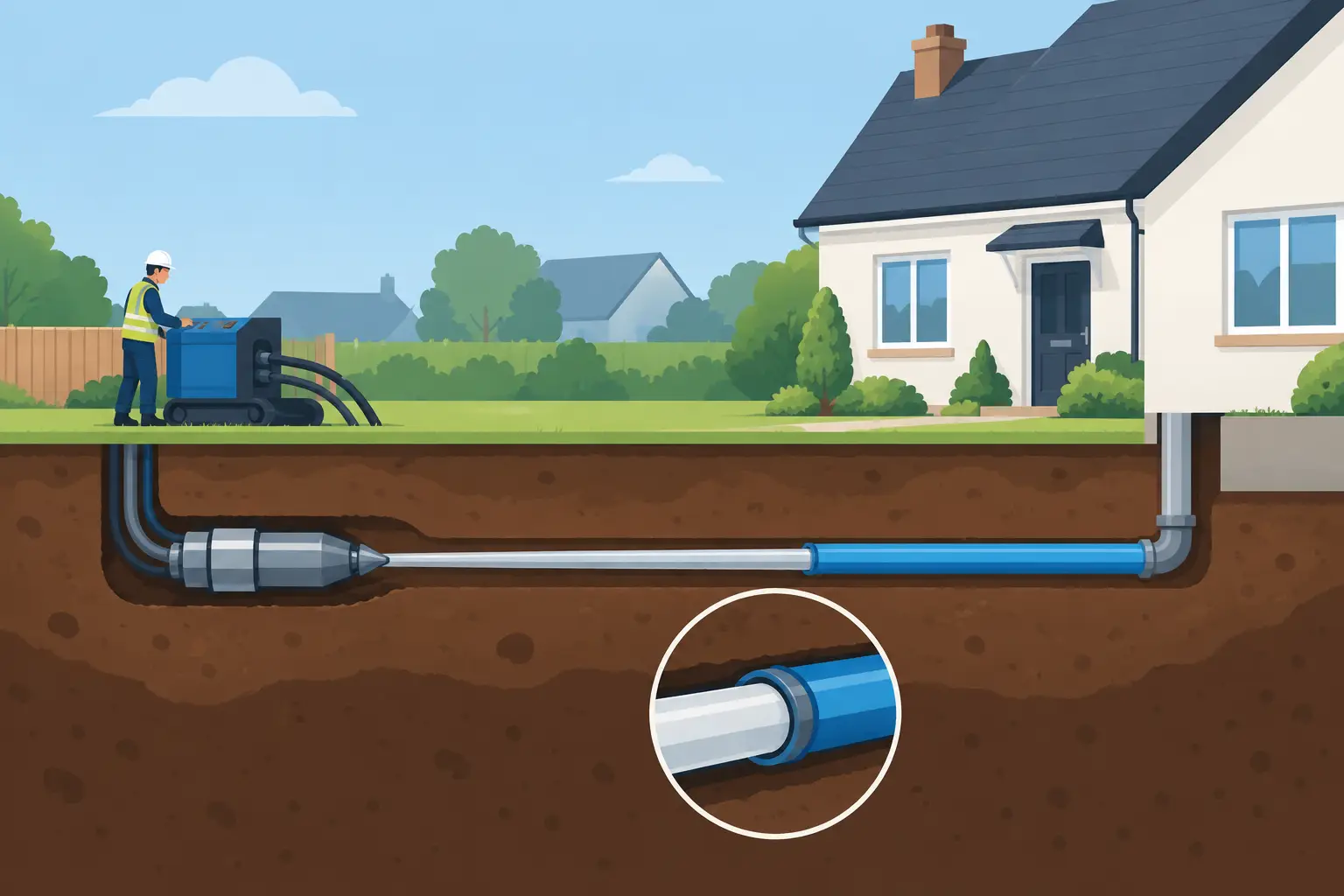
Trenchless installation reduces that impact by creating a bore beneath the surface or by using the existing pipe route. Instead of excavating the full length, engineers normally work from carefully positioned launch and reception pits. The visible disturbance is confined to those areas.
For domestic water supply work, the practical benefits are clear: faster installation, less spoil to remove, reduced reinstatement costs and a tidier finish. For commercial sites, avoiding an open trench can also reduce disruption to parking, pedestrian routes and daily operations.
The method still needs to be planned properly. Underground utility records, a site survey and safe working procedures are essential. The lowest initial price is rarely good value if the contractor has not allowed for service avoidance, correct pipe depth or compliant connection work.
Best trenchless installation methods for water pipes
Trenchless moling for homes and smaller pipe runs
Impact moling, usually shortened to moling, is often the preferred solution for replacing lead water pipes or installing a new private water supply to a house. A pneumatically powered mole travels through the ground, creating a route for a new pipe without excavating a continuous trench.
A small launch pit is made at one end and a reception pit at the other. The new pipe is then drawn through the bore and connected to the internal supply and boundary connection as required. This approach works particularly well beneath front gardens, paths, tarmac and driveways where a direct route is available.
Moling is fast and cost effective on suitable sites, but ground conditions matter. It performs best in soils that can hold a bore, such as clay and firm ground. Very loose ground, substantial rubble, large tree roots, buried concrete or unknown obstructions can make it unsuitable or require a change in approach.
It is also best for relatively straight runs. If the proposed route needs to turn sharply around extensions, retaining walls or existing services, a different technique may be safer and more accurate.
Horizontal directional drilling for longer or complex routes
Horizontal directional drilling, known as HDD, is a steerable trenchless method used where the route is longer, deeper or more technically demanding. Rather than simply driving a mole in a straight line, the drilling head can be guided along a planned path. The bore can then be enlarged and the new pipe pulled into place.
HDD is a strong option for water mains installations, supply diversions and pipework that needs to pass beneath roads, car parks, landscaped grounds or other sensitive surfaces. It gives greater control over depth and direction than moling, which is valuable where there are several services to avoid.
The trade-off is that HDD requires more equipment, space and planning. It may not be the most economical choice for a short, uncomplicated domestic lead pipe replacement. On larger residential developments, commercial properties and constrained sites, however, the reduced excavation can offer significant overall savings.
Pipe bursting when an existing pipe must be replaced
Pipe bursting is a replacement technique rather than a method for creating a completely new route. A bursting head is pulled through a failed or undersized pipe, breaking it outward while drawing a replacement pipe behind it.
It can be useful where an old water or drainage pipe follows a suitable route but is too damaged for repair. It avoids excavating the whole line, although access pits are still needed at either end and at certain connections.
Not every old pipe can be burst safely. Nearby services, shallow cover, unstable ground and the type of existing pipe all need consideration. A survey helps establish whether bursting is appropriate or whether a new bore gives more control.
Pipe lining for drainage repairs, not new water supplies
Drain lining is often grouped with trenchless methods, but it serves a different purpose. A resin liner is installed inside an existing drain to seal cracks, joints or local defects. Patch lining can repair a small section, while full-length lining can rehabilitate a longer run.
It is an excellent no-dig repair option for drains beneath extensions, patios and landscaped areas. It does not replace a lead water supply or install a new water main, so it should not be presented as an alternative to moling or HDD for potable water pipework.
Choosing between moling and HDD
For many houses in Manchester, Stockport, Warrington, Cheshire and the surrounding areas, moling is the simple solution for a lead pipe replacement. The route is often from the boundary stop tap to the house, and avoiding a trench across the front garden or driveway is the main priority.
HDD becomes more attractive when the route has to cross a wider area, pass under hardstanding, avoid known utilities or meet a more precise depth requirement. It is also commonly considered for commercial water supply works and diversions where site access and operational continuity need careful management.
The best choice is not simply the method with the least digging. It is the method that reaches the required connection point safely, protects existing services, suits the ground and leaves the property properly reinstated. A small excavation in the right place is preferable to forcing a no-dig technique where conditions do not support it.
What a proper trenchless survey should cover
Before work starts, the contractor should establish the existing supply route and identify likely obstacles. On water supply projects, this includes locating the internal stop tap, checking the boundary connection and confirming whether the current pipe is lead, plastic or another material.
The survey should also consider access for machinery, the position of gas and electric services, drainage runs, external structures and the surface finish to be protected. On commercial premises, it may also involve site rules, traffic management, permits and agreed working hours.
For drainage work, a CCTV drain survey provides the evidence needed to decide whether lining, patch repair, excavation or replacement is appropriate. Guesswork can lead to the wrong repair, particularly where recurring blockages are caused by collapsed pipework, root ingress or poor falls.
A clear quotation should explain the proposed method, what is included in reinstatement and any assumptions that could affect the job. It should also set out how unexpected underground conditions will be handled. This is particularly important on older properties, where records may be incomplete.
Compliance, connections and workmanship
Installing pipework is only part of the job. A new drinking water supply must use suitable materials, be installed at the correct depth and be connected in line with the relevant water company requirements. Work on private supply pipes should be completed by competent specialists who understand the approval process and hygiene controls.
Watermains & Drains UK carries out trenchless water supply and drainage work with a focus on minimal disruption, backed by WIAPS and Watersafe accreditations, £10 million public liability insurance and a 25-year workmanship guarantee. Those assurances matter when pipework is being installed beneath valuable paving, gardens or operational premises.
Ask who will carry out the work, how services will be checked, whether spoil removal and reinstatement are included, and what guarantee applies to the installation. A professional answer should be specific rather than vague.
When excavation is still the sensible option
There are circumstances where conventional excavation remains the safest and most cost-effective route. A pipe may be severely collapsed, surrounded by concrete, inaccessible to drilling equipment or positioned too close to other critical utilities. A new manhole, chamber or drainage connection may also require open excavation.
This is not a failure of trenchless technology. It is good judgement. The aim is to limit unnecessary digging while completing a safe, durable installation that can be maintained in future.
If you are replacing a lead supply, planning a new water connection or dealing with damaged underground drainage, start with a site survey rather than an assumption about how much needs to be dug up. The right trenchless method can protect the parts of your property you have invested in, while giving you a reliable pipe installation beneath them.





