

Does Moling Work Under Driveways? What to Know
A driveway is often the reason property owners put off replacing an old water supply pipe. Nobody wants paving lifted, concrete broken out or a newly laid surface turned into a building site. So, does moling work under driveways? In many cases, yes. It is one of the most effective ways to install a new water pipe beneath a driveway without excavating a full trench across it.
Moling is not suitable for every property, however. The ground conditions, route, depth, existing services and type of driveway all need checking before a contractor can recommend it. A proper site survey turns a promising no-dig option into a safe, planned installation.
How moling works beneath a driveway
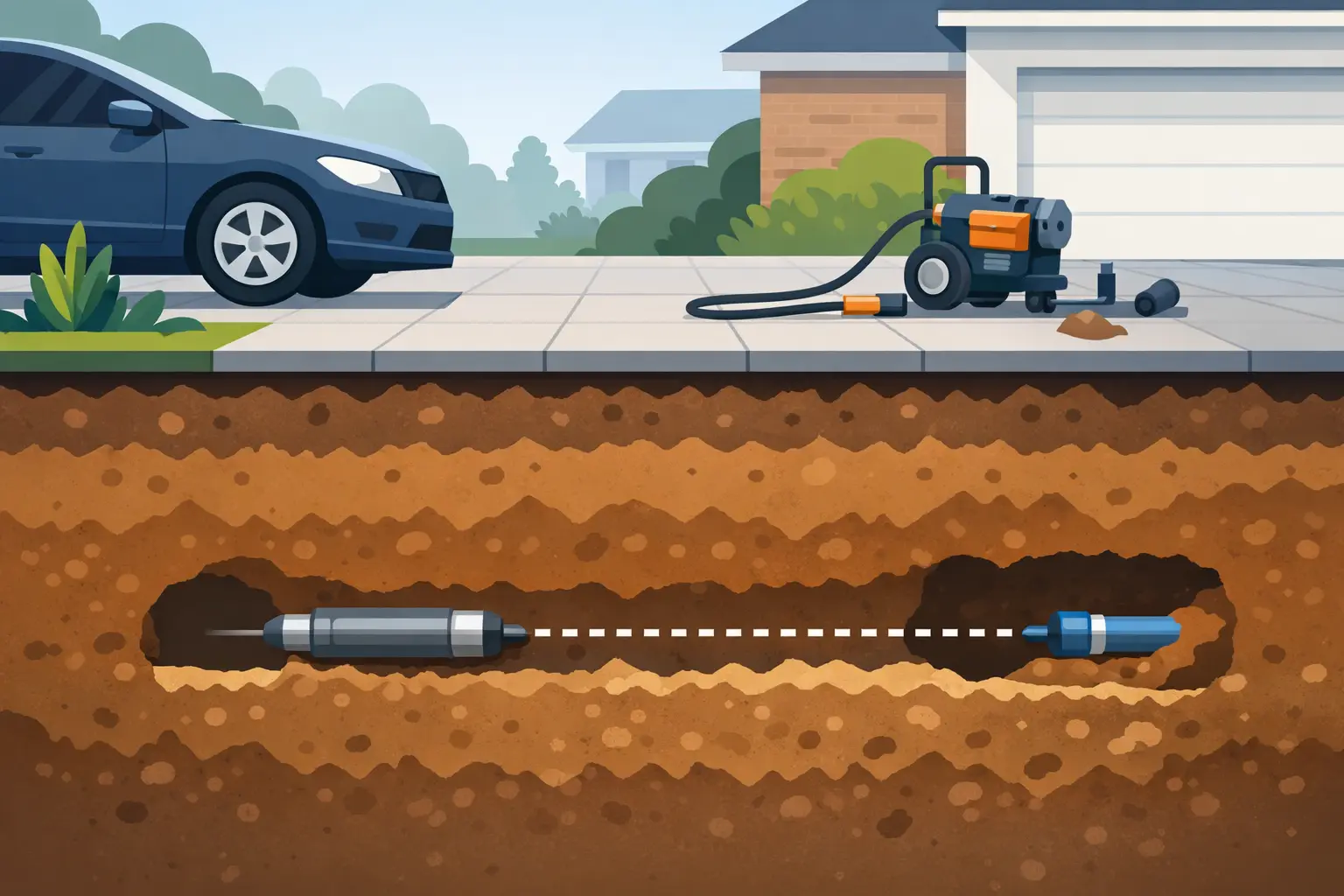
Moling is a trenchless technique used mainly for installing or replacing small-diameter water supply pipes. Rather than digging a continuous trench, contractors excavate a small launch pit at one end of the route and a receiving pit at the other. A pneumatic mole is then driven through the ground beneath the driveway, creating a bore for the new pipe.
The new pipe, usually a modern blue polyethylene water service pipe, is pulled through the bore and connected at each end. The pits are backfilled and reinstated once testing is complete. Instead of disturbing the full width of the drive, work is generally limited to two localised areas.
For a homeowner replacing a lead supply pipe, this can mean avoiding the cost, mess and visual impact of lifting block paving, tarmac or concrete. It can also reduce the time spent with access restricted to the property.
When does moling work under driveways?
Moling works best where there is a reasonably direct route through suitable soil and enough space for safe launch and receiving pits. It is particularly effective for many domestic water supply upgrades, including lead pipe replacement from the external stop tap or boundary to the property.
A driveway made from block paving, resin-bound surfacing, tarmac or concrete can often be crossed without opening it up. This is especially valuable where the surface is expensive to reinstate, carefully matched to the rest of the property or has only recently been installed.
The technique is also useful where the pipe route passes beneath a front garden and driveway before reaching the house. A contractor may be able to mole beneath the hardstanding while using a small excavation in a planting bed, verge or less visible edge of the driveway. The aim is always the least disruption possible, not simply avoiding digging at all costs.
Ground conditions make the difference
Firm, cohesive ground is generally favourable for moling. Clay and many compacted soils can be suitable, provided the route has been assessed properly. Loose ground, heavily made-up land, large stones, rubble, deep tree roots or very wet ground can make the work more difficult and less predictable.
Rocky ground can prevent a mole from maintaining its intended route, while voids or unstable material can increase the risk of movement beneath the surface. In these circumstances, a short section of careful excavation or an alternative trenchless method may provide the safer result.
The question is not simply whether a mole can physically travel under a driveway. It is whether it can do so at the correct depth and on a controlled route, without putting the driveway, existing services or new pipe at risk.
Existing services must be located first
The area beneath a driveway may contain more than a water pipe. Gas, electric, telecoms, drainage, private cables and older redundant services are all common. Their location is not always obvious, particularly on older properties where previous works may be poorly recorded.
A competent contractor will assess the proposed route, review available service information and use locating equipment where appropriate. Trial holes may be needed near known services. This is a critical part of the job: moling should never be treated as a blind operation beneath a driveway.
The benefits of moling for water pipe replacement
The main benefit is reduced excavation. Traditional trenching across a driveway can involve lifting the surface, removing sub-base material, digging the trench, installing the pipe, compacting the ground and rebuilding each layer. Even with good reinstatement, matching the original finish can be difficult.
Moling avoids most of that process. The driveway remains largely intact, which usually means less spoil, less noise, fewer vehicle movements and a tidier site. It can also be faster than full excavation, particularly where the distance across the driveway is short and the access points are straightforward.
For landlords and commercial property managers, less disruption can be just as valuable as the reduced reinstatement work. Keeping a tenant entrance, parking area or customer access route in better condition helps limit avoidable inconvenience.
There can be a cost benefit too, but it is not automatic. A straightforward moling job may be more cost effective than breaking out and rebuilding a driveway. Complex ground, difficult access, deep services or several changes in direction may remove that advantage. Clear quoting should explain the proposed method and any factors that could affect the price.
When excavation may be the better option
No-dig methods are not a cure-all. If the new pipe needs to follow a tight route, cross several known services, avoid a large tree or pass through unsuitable ground, excavation may be the more controlled choice. It may also be necessary if the existing pipe has failed beneath a building, if connections need major alteration or if there is no safe space for a launch pit.
Drainage work is different again. Moling is commonly associated with water supply pipe installation, not repairing every type of drain. Damaged drains may need CCTV investigation first, followed by patch lining, excavation or a replacement section depending on the defect, pipe material and fall.
For longer or more technically demanding routes, horizontal directional drilling, often called HDD, may be considered. HDD offers greater steering control than a pneumatic mole and can be appropriate for larger-diameter pipes, more complex crossings or commercial installations. The right method depends on the site, not on which technique sounds least disruptive.
What to expect from a professional moling survey
A survey should begin with the practical questions: where does the new supply start, where does it need to finish, and what lies between those points? The contractor should inspect access, identify likely launch and receiving pit locations and consider the condition of the driveway and surrounding ground.
They should also establish whether the work is on your private supply pipe or involves the water company side of the connection. In most cases, a homeowner is responsible for the private supply pipe running from the property to the boundary or external stop tap, but responsibilities can vary. Clarifying this before work begins prevents delays and unexpected scope changes.
Ask how the route will be checked for services, what depth the pipe will be installed at, how the pits will be reinstated and whether pressure testing is included. If the job involves lead pipe replacement, ask whether the installer holds relevant water industry approvals. WIAPS and Watersafe recognition provide useful reassurance that the work is being completed by an approved specialist.
A good contractor will not promise moling before understanding the site. They will explain where it is suitable, where there are risks and what the fallback plan is if an obstruction is found.
Protecting the driveway during the work
Although moling avoids a full trench, the driveway still needs protecting. Plant and equipment should be positioned carefully, and the launch and receiving pits should be located to minimise visible disruption where possible. If a pit must be formed in the driveway itself, a clean, durable reinstatement plan matters.
The depth of the bore is also important. A pipe installed too shallowly can be vulnerable to future landscaping, fence posts or vehicle loading. The contractor should use an appropriate route and depth for the installation, rather than taking the shortest possible line.
After installation, the new supply should be pressure tested and the site left clean and safe. For works affecting a driveway entrance, access arrangements should be discussed in advance so households, tenants or business users know when vehicles may need to be moved.
If your water supply pipe runs beneath a driveway, do not assume the surface has to be broken up. A site survey can establish whether moling offers the simple, low-disruption solution – and whether a specialist alternative would give you a better long-term result.





