

How to Test for Lead Pipes at Home
If your property was built before the 1970s and the incoming water pipe has never been upgraded, there is a fair chance you have already wondered how to test for lead pipes without tearing up the drive or guessing wrong. That is a sensible question. Lead supply pipes are still found in many older homes across the North West, and while not every old pipe is lead, it is worth checking properly rather than relying on age alone.
The good news is that a first check is usually straightforward. The less helpful news is that no single sign gives a complete answer. In practice, you are looking for a combination of visual clues, a simple scratch test, property history, and in some cases a water test or professional inspection.
How to test for lead pipes without guesswork
The first place to check is the incoming water supply pipe where it enters the property. In many houses, that will be under the kitchen sink, near the internal stop tap, in a utility room, cellar, or where the main rises through the floor. If you live in a flat, access can be less obvious, and the supply arrangement may be shared, so the answer can take a little more tracing.
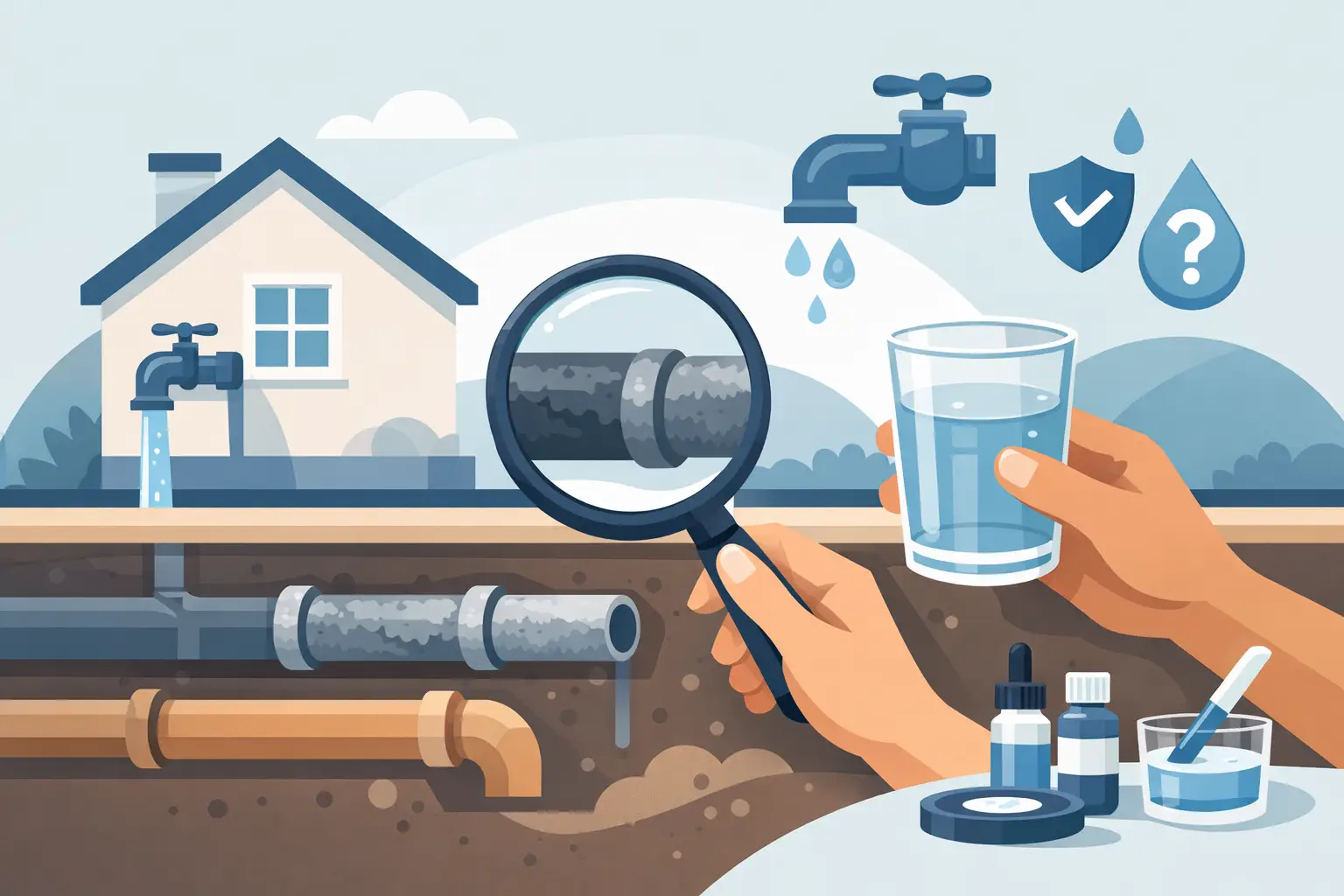
A lead pipe usually looks dull grey rather than bright copper or modern blue plastic. It often feels softer than expected. If you gently scratch the surface with a coin, key, or screwdriver, lead will reveal a shiny silver-coloured metal underneath. Copper will not do that, and plastic obviously will not either. Lead pipes also tend to have swollen-looking joints rather than neat modern fittings.
That said, painted pipework can be misleading. So can pipe sections that have been partly replaced over time. It is quite common to find a newer internal section connected to an older external lead supply outside the property line. That is why a quick look indoors is useful, but not always the full story.
Simple signs your water supply pipe may be lead
Age is one clue. Homes built before 1970 are more likely to have lead supply pipes, especially Victorian and early to mid-20th century properties. If your house has had little infrastructure work done, the chances increase.
The next clue is the pipe material itself. A dull grey pipe that scratches shiny is the classic sign. If it bends slightly when pressed or feels softer than copper, that is another indicator. Some owners also notice old repairs that look wiped or bulged rather than mechanically jointed.
Water appearance and taste are less reliable. Lead in drinking water usually cannot be seen, smelt, or tasted. Clear water does not prove the pipe is safe, and poor-tasting water does not automatically mean lead. If you are only judging by what comes out of the tap, you can easily miss the real issue.
The at-home checks that are worth doing
Start indoors and trace the pipe from the internal stop tap backwards as far as you can. Look for a change in material. You may find copper inside but an older pipe entering through the wall or floor. If there is boxing-in or kitchen units in the way, do not force access or start opening floors unless you know what you are looking at.
If the pipe is exposed, inspect the colour and surface. Lead is typically matte grey and can look slightly uneven. Gently scratch a small hidden area. If it becomes bright and silvery, that strongly suggests lead.
Then check any external meter box, if you have one. In some cases, you can see the customer-side pipework there, though not always clearly enough to confirm material. If the route from the boundary to the house is old and there is no record of replacement, that adds weight to your findings.
It also helps to ask your water supplier whether there is any record of lead pipe replacement in the street or at your property. Their records may not tell the whole story, but they can provide useful context.
When a water test makes sense
If you suspect lead but cannot confirm the pipe material, a laboratory water test can help. This is particularly useful where pipes are hidden, shared, or partly replaced. A water sample can show whether lead is present in the drinking water above recommended levels.
The result needs a bit of interpretation. A low reading does not always mean there is no lead pipe, because water chemistry, flow patterns, and how long water has stood in the pipe can affect the sample. A high reading is more clear-cut and usually points to the need for action.
For landlords and commercial property managers, a formal test may also support risk assessment and compliance decisions. If the building houses tenants, staff, children, or vulnerable occupants, relying on assumptions is not a sensible approach.
Why pipe identification and water testing are not the same thing
This is where many people get caught out. Testing the water tells you what is in the water sample taken that day under those conditions. Testing for lead pipes means identifying whether the supply infrastructure itself contains lead.
Those are related, but not identical, questions. You can have a lead pipe and a sample that comes back low. You can also have internal fittings or historical contamination that affects water quality even where most of the pipework has been updated. If your aim is to remove long-term uncertainty, identifying and replacing the lead supply pipe is usually the clearer solution.
How professionals test for lead pipes
A proper inspection goes beyond the visible section under the sink. A specialist contractor will assess the incoming water service, entry point, meter position, likely route to the boundary, and whether there are signs of previous replacement. In some cases, small trial holes may be used to confirm the pipe material outside, especially where the internal section has already been changed.
This is also the point where method matters. If lead replacement is needed, many homeowners worry about trenches across drives, paths, or gardens. Modern trenchless installation often avoids that. Moling allows a new water supply pipe to be installed with minimal excavation, which is usually faster, tidier, and less disruptive than open-cut digging.
For older occupied homes, that practical difference matters as much as the pipe material itself. The right contractor should be able to confirm what is there, explain the replacement route clearly, and quote for reinstatement properly rather than leaving you with a vague allowance and a damaged driveway.
What to do if you find lead pipes
If your checks strongly suggest lead, the sensible next step is to arrange confirmation and a replacement quote. Temporary measures such as flushing taps can reduce exposure in some situations, particularly first thing in the morning or after water has been standing in the pipe. But that is not a long-term fix.
Full replacement of the private supply pipe is usually the best answer. It removes the uncertainty, improves water quality confidence, and often upgrades flow and reliability at the same time. If the pipe is old enough to be lead, it may also be more prone to leaks or poor condition generally.
For some properties, only part of the supply has been renewed. That can still leave a lead section outside or near the boundary. Partial replacement is better than none, but it does not always solve the whole problem. A proper site assessment is the only way to know.
When to get help straight away
If you are buying an older property, planning renovation work, managing rented accommodation, or responsible for a commercial building, it is worth dealing with this early. The same applies if there are children in the property or if you have already identified a grey metallic incoming pipe and want certainty.
This is not a job for guesswork or broad assumptions based on postcode and property age alone. A qualified water supply specialist can confirm the material, advise on the route of the existing service, and explain the least disruptive replacement method if needed. That is the approach taken by Watermains & Drains UK, where the focus is on fast quoting, compliant installation, and tidy reinstatement rather than unnecessary excavation.
If you are working out how to test for lead pipes, the key point is simple. Start with the visible checks, treat mixed evidence cautiously, and do not confuse a quick look with a proper answer. A small amount of investigation now can prevent a much bigger question hanging over the property later.
If there is any doubt, it is better to confirm the pipe and know where you stand than to keep wondering every time you fill a glass from the tap.





