

How to Test Lead Pipes at Your UK Property
A lead service pipe is usually out of sight, running from the water main in the street to your property. That makes it easy to overlook, even where the internal plumbing has been updated. Knowing how to test lead pipes gives homeowners, landlords and facilities teams a clear starting point before arranging replacement work.
The aim is not to make a guess from one visible section of pipe. A proper check considers the age of the building, the material of the incoming supply, water test results where needed, and the point at which responsibility changes between the water company and the property owner. This avoids unnecessary excavation and helps you choose the most cost-effective solution.
Why lead pipe testing matters
Lead was widely used for service pipes on older UK properties, particularly those built before the 1970s. When water sits in or passes through a lead pipe, small amounts of lead can dissolve into the supply. The amount can vary depending on water chemistry, how long the water has stood in the pipe and the condition of the pipework.
Drinking water regulations set a strict limit for lead. The practical concern is greatest for households with young children, pregnant people and infants, although reducing exposure is sensible for everyone. For landlords and commercial property managers, identifying lead pipework is also part of managing water quality responsibly and responding properly to tenant or occupier concerns.
A visible lead pipe does not automatically mean the water exceeds the legal limit. Equally, clear-looking water does not prove the supply is free from lead. Testing and inspection answer different questions: one identifies the pipe material, while the other measures lead in the water.
How to test lead pipes: start with a visual inspection
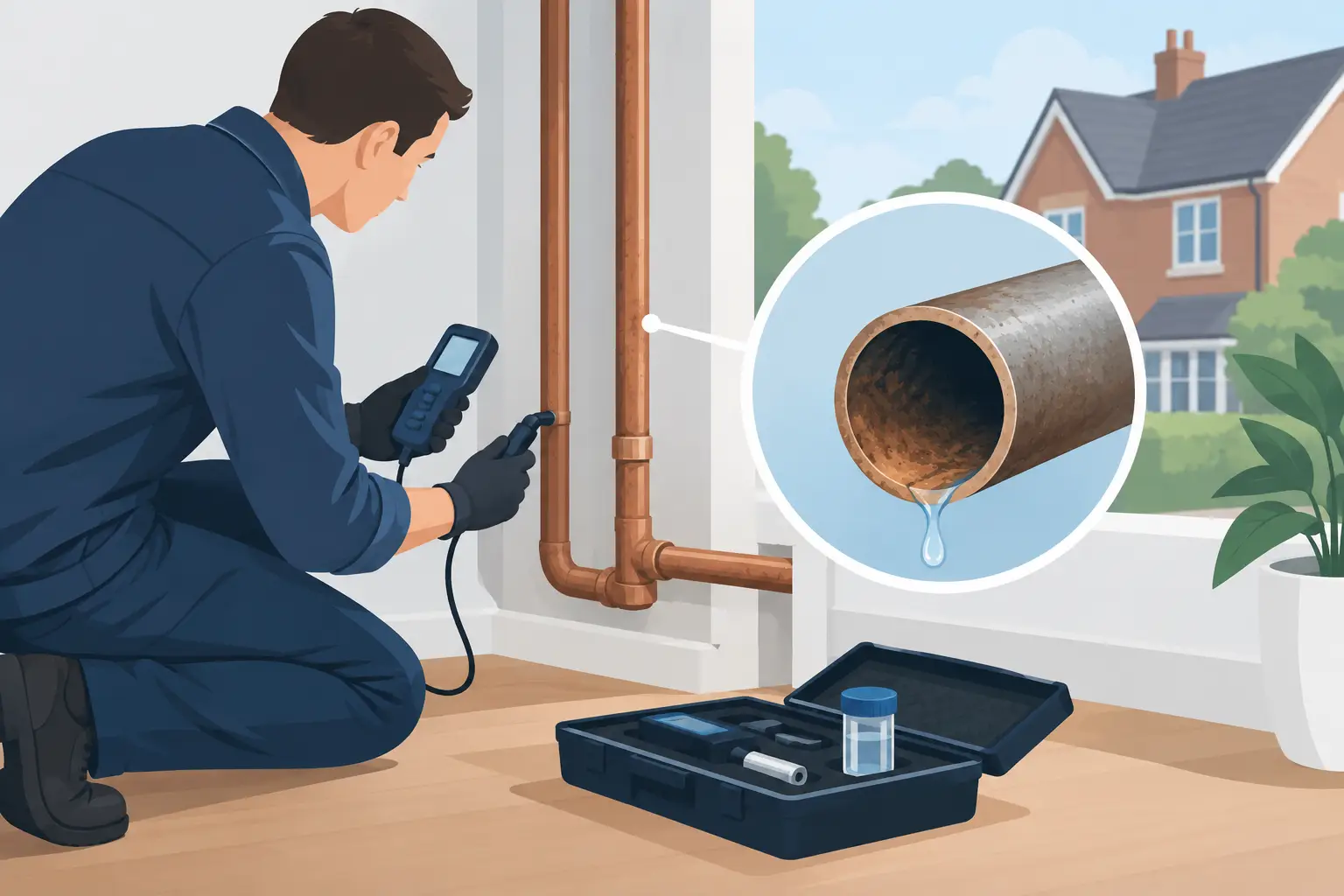
The most accessible place to inspect is usually close to the internal stop tap, often beneath the kitchen sink, in a utility room, cellar or meter cupboard. Look for the pipe entering the property from outside, rather than newer pipework fitted after it reaches the stop tap.
Lead pipe is generally dull grey, soft and slightly uneven in appearance. It may have swollen joints or gentle bends, because lead was easily shaped during installation. Copper is reddish-brown, plastic is usually blue or black, and galvanised steel tends to be harder, darker and may show corrosion.
If you can safely access a small, unpainted area, gently rubbing it with fine sandpaper can reveal a brighter silver-grey surface beneath. Lead is also soft enough to mark lightly with a coin. Do not use a knife, saw or heavy tool, and do not damage any pipework. Pipe material can be misleading where it has been painted, wrapped or repaired over the years, so treat this as an initial indication rather than final proof.
It is also worth checking any external section near the boundary, meter chamber or point where the service enters the building. Never lift covers you cannot safely handle or interfere with water company equipment. If access is limited, a specialist contractor can assess the route and condition of the private supply without turning the inspection into a disruptive excavation project.
Consider the age and history of the property
A property built before 1970 is more likely to have had a lead service pipe originally, but that does not confirm one remains. Many homes have been partially upgraded. For example, the internal pipework may be copper or plastic while the underground pipe from the boundary to the stop tap remains lead.
Ask previous owners, landlords, managing agents or contractors whether a water supply replacement has been completed. Invoices, building records and water company correspondence can help. If the paperwork only refers to a new kitchen, boiler or bathroom, it should not be assumed that the incoming supply was renewed at the same time.
When a water sample is the right test
A laboratory water test is the reliable way to establish whether lead is present in the water supply at the time of sampling. Your water company may offer testing where there is a concern about lead pipes, and its local guidance will explain the process. Private laboratory testing may also be appropriate for landlords, commercial sites or properties requiring a documented result.
Follow the sampling instructions exactly. Some tests require a first-draw sample after water has stood unused for several hours, often overnight, because this can show the effect of water sitting in the pipe. Other investigations use flushed samples to understand the water coming through after the stagnant section has cleared. The difference matters, so do not run the tap, clean the tap outlet or take a sample at a random time unless the test provider instructs you to do so.
Home lead test kits can be useful as a prompt to seek further advice, but they should not be treated as a definitive compliance test. Their accuracy, sampling method and sensitivity vary. Where a result will influence replacement work, tenant communication or a health-related decision, use an accredited laboratory or speak to your water supplier.
Understand which section of pipe is lead
The service pipe is often split into two sections. The communication pipe generally runs from the water main to the property boundary and is normally the water company’s responsibility. The supply pipe runs from the boundary into the property and is usually the owner’s responsibility.
This arrangement can vary, especially on shared supplies, flats, converted buildings and older terraces. One pipe may serve more than one property before branching internally. Replacing only the visible pipe inside a building will not remove lead from the underground section if it remains in place.
Your water company may replace its section when the private lead supply pipe is replaced, subject to its policy and site conditions. Confirm this before work starts. A professional site survey can identify the likely route, locate the stop tap and meter, and establish whether neighbouring properties or shared access affect the proposed installation.
Signs that make replacement more urgent
A confirmed lead pipe is normally best replaced rather than left in service, even if a single water result is below the limit. Water quality can change over time, and retaining an ageing lead supply can create uncertainty when selling, letting or refurbishing a property.
Act promptly if you have a young family, are planning a kitchen or driveway project, manage a rental property, or have repeated concerns about water quality. Low pressure, recurring leaks, discoloured water and unexplained damp around the incoming supply are separate issues, but they can make a full supply replacement the sensible option rather than carrying out piecemeal repairs.
Until replacement is arranged, use only cold water from the mains tap for drinking and cooking, then heat it if required. Water from the hot tap may have spent longer in pipework and cylinders. If water has been unused for several hours, running the cold tap briefly before use can reduce the amount of water that has sat in the service pipe. This is a temporary precaution, not a substitute for replacing confirmed lead pipework.
Choosing the least disruptive replacement method
Traditional replacement can involve opening a trench across a front garden, driveway or path. That is sometimes necessary, particularly where the route is obstructed or other services need investigation. However, it is not the only option.
Trenchless moling can install a new water supply pipe underground through small entry and exit pits. A pneumatic mole creates a route beneath lawns, paths and many driveways, reducing excavation and reinstatement. The suitability depends on ground conditions, the depth and route of the existing service, nearby utilities and available access. For longer or more complex routes, horizontal directional drilling may offer a controlled alternative.
The new pipe should be correctly connected, pressure tested and commissioned in line with the relevant water regulations. This is not work for an unqualified general builder. Using a WIAPS or Watersafe-approved contractor gives reassurance that the installation is being carried out by people who understand the standards required for drinking water supplies.
Watermains & Drains UK surveys lead supply replacements across the North West and can advise whether moling, drilling or targeted excavation provides the cleanest practical route. The focus should be on a properly installed new supply, tidy reinstatement and as little disruption to your home, tenants or trading hours as possible.
If you suspect lead, start by locating the incoming pipe and checking its appearance, then arrange a proper assessment rather than relying on assumptions. A clear answer now makes it far easier to plan replacement work around your property, rather than dealing with an avoidable problem later.





