

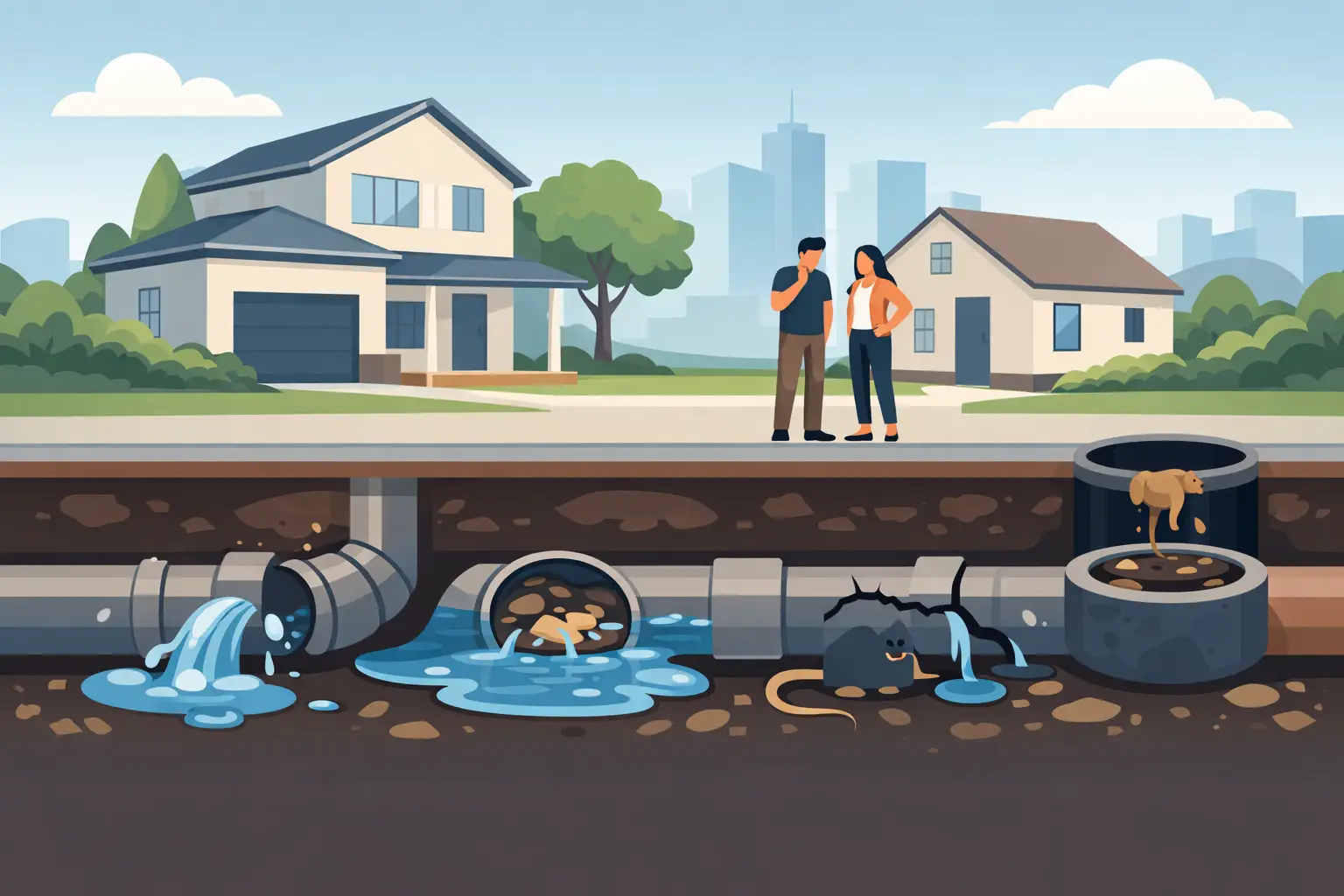
Signs Shared Drains Need Repair at Your Property
A blocked toilet after heavy use is frustrating. The same toilet backing up after a neighbour runs their washing machine is a different kind of warning. These are often signs shared drains need repair, particularly where two or more homes connect to the same underground pipework before it joins the public sewer.
Shared drainage faults can affect more than one household, create uncertainty over responsibility and, if left unresolved, lead to repeat blockages, foul odours and damage around the property. Acting early gives you more repair options and usually keeps disruption, cost and inconvenience under control.
What is a shared drain?
A drain carries wastewater from a single property to a point where it joins pipework serving another property. Once it serves more than one home, it is generally described as a shared drain. A sewer carries wastewater from more than one property or building.
For many properties in England and Wales, shared drains and sewers transferred to the local water and sewerage company in 2011. That does not mean every pipe is automatically their responsibility. Private pipework within your boundary, pipes that serve only your property, and unusual arrangements can still fall to the owner. In Scotland and Northern Ireland, the arrangements can differ.
The practical point is simple: do not assume the pipe is yours to repair, or that it is not. A professional drain survey can establish where the defect sits, which properties it serves and what repair is appropriate. This is especially useful for landlords, managing agents and commercial property teams who need clear evidence before arranging works.
Signs shared drains need repair rather than another unblock
One isolated blockage may be caused by wipes, grease, sanitary products or a build-up of debris. Repeated problems affecting more than one property point more strongly towards a damaged, displaced or poorly flowing shared pipe.
Neighbours experience the same drainage problems
If nearby homes are reporting slow toilets, gurgling plugholes or backed-up drains at roughly the same time, the issue is unlikely to be limited to an internal waste pipe. A restriction or collapse further along the shared run may be holding wastewater back.
This is common in terraced streets, converted properties and older developments around Manchester, Stockport, Warrington and Cheshire, where drainage layouts may have been altered over decades. Speak to affected neighbours where practical, but avoid each household arranging separate clearance work without identifying the underlying cause.
Drains block repeatedly after being cleared
A drain that flows normally for a few days or weeks after jetting, then blocks again, needs investigation. Jetting removes the immediate obstruction but cannot correct a cracked pipe, root ingress, a section with poor falls or a joint that has moved out of line.
Repeat call-outs are a false economy when the pipe has a structural defect. CCTV drainage equipment allows the contractor to inspect the pipe internally and pinpoint the fault, rather than excavating based on guesswork.
Foul smells persist outdoors or inside the building
A lingering sewage smell near a manhole cover, external wall, ground-floor bathroom or kitchen can indicate that wastewater is escaping from damaged pipework. It can also be caused by a dry trap or a local blockage, so it is not proof of a shared drain defect on its own.
However, when smells occur alongside slow drainage, gurgling or neighbouring problems, they warrant prompt attention. Foul water should remain contained within the drainage system. Persistent odours are not something to cover up with air freshener and hope will disappear.
Manholes are overflowing or unusually full
Lift the cover only if it is safe to do so and you can avoid contact with wastewater. A chamber that is full when no fixtures are in use may indicate a downstream blockage. If the level rises when a neighbour discharges water, that is a useful indication of a shared connection beyond the chamber.
Overflowing manholes should be treated as urgent, particularly where children, pets, customers or tenants could come into contact with contaminated water. Keep people away from the area and arrange professional attendance rather than attempting to rod a deep or unknown drainage run yourself.
Ground is sinking, wet or greener around the drainage route
A broken underground drain does not always announce itself with a blockage. Leaking wastewater can wash fine soil into the pipe or soften the ground around it. You may notice a dip in a driveway, loose paving, a persistently damp patch or an unusually healthy strip of grass during dry weather.
These symptoms can have other causes, including surface-water issues or a leaking water supply pipe. A CCTV survey, sometimes supported by tracing or dye testing, helps separate drainage faults from other underground problems. That distinction matters because the repair method and responsible party may be different.
Rods or jetting equipment hit the same point every time
When a drainage engineer repeatedly encounters an obstruction at a fixed distance, there may be a displaced joint, root mass, collapse or sharp change in direction. Older clay drains are particularly vulnerable to root ingress at joints, though newer plastic systems can also suffer from poor installation or movement.
The correct next step is normally a camera inspection. Continuing to force equipment through a damaged pipe risks worsening the defect and provides no reliable record of its condition.
Why shared drainage problems should not be delayed
Shared drains carry a greater volume of wastewater than a private run. When their capacity is reduced, the first property to experience a backup may not be the one closest to the fault. This can make neighbour discussions awkward, but it also makes evidence vital.
For landlords and commercial premises, recurring drainage failures can affect habitability, customer access and day-to-day operations. For homeowners, the risk is often mess, odour and avoidable damage to gardens, paths or internal finishes. Insurers may also need clear information about the cause and extent of a loss.
A clear CCTV report can show pipe depth, diameter, material, direction of flow and the exact location of a defect. It gives property owners, water companies and insurers a factual basis for deciding what happens next.
The repair options depend on the defect
Not every shared drain needs excavation. If the pipe is broadly sound but has a local crack, leaking joint or root-damaged section, patch lining can create a new sealed section inside the existing pipe. It is a fast, cost-effective option where access and pipe condition are suitable.
For longer runs with multiple fractures or widespread root ingress, full drain lining may be considered. This avoids digging across a drive, landscaped garden or paved access route, although it is not suitable where the pipe has fully collapsed, has severe changes in level or requires capacity improvements.
Excavation remains the right answer in some cases, especially for collapsed pipework, significant subsidence, badly displaced sections or drains installed with inadequate falls. A competent contractor should explain why a no-dig repair is feasible or why it is not, then plan reinstatement carefully if excavation is needed.
Watermains & Drains UK uses CCTV investigation and targeted drainage repairs to identify the simplest suitable solution, with methods selected to minimise disruption wherever site conditions allow.
What to do when you suspect a shared drain fault
Start by limiting water use if toilets are rising, external chambers are overflowing or wastewater is close to entering the property. Do not use chemical drain cleaners in a suspected shared-drain blockage. They rarely solve a structural problem and can create a hazard for anyone working on the system afterwards.
Take photographs of visible overflow, standing water or ground movement, and make a note of when the issue occurs. If neighbours are affected, record that too. Then arrange a professional assessment with drainage clearance where required and a CCTV survey if the fault is recurring or likely to be structural.
Ask for the findings in plain language. You need to know whether the fault is a simple obstruction, where it lies in relation to property boundaries, whether the drain is shared, and whether the evidence suggests referral to the sewerage company or private repair work. For planned repairs, obtain a clear scope that covers access, repair method, testing and reinstatement.
A shared drain does not have to become a recurring source of disruption. Early investigation protects the property, gives everyone involved clearer information and often turns an unpleasant emergency into a straightforward, targeted repair.





