Shared Water Supply Pipe Replacement: Who Pays?
If your neighbour’s tap turns on and your pressure drops, you probably share more than a fence line.
Across the North West, plenty of older terraces, semis and converted properties are still fed by a single incoming water supply that splits to serve two or more homes. It can work for decades without anyone thinking about it – right up until a leak appears under a driveway, the water company flags lead on the line, or one property suddenly loses pressure.
Shared water supply pipe replacement is rarely complicated from an engineering point of view. The tricky bit is responsibility: who owns which section, who pays, and how you get the work done without turning it into a neighbour dispute or a weeks-long excavation.
What a “shared supply” actually means
A shared supply typically describes one communication pipe (the pipe from the water main in the street to the boundary) feeding more than one property, or a single supply that then branches off to multiple stop taps.
In practical terms you might see:
- One stop tap in the pavement serving two houses
- A single supply entering one home, then a branch running out to the neighbour
- A supply running under a shared access path, with both properties connected along the run
It is most common on older housing stock where a single lead pipe once served multiple properties. Over time, kitchens and bathrooms move, extensions go on, and nobody is quite sure where the pipe runs until it fails.
When shared water supply pipe replacement becomes the sensible option
A shared supply can be left alone if it is sound, gives adequate flow, and meets current expectations. Replacement is usually triggered by a problem that will keep coming back if you only patch it.
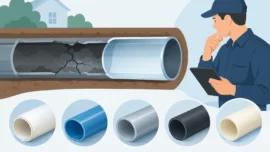
Lead pipe and water quality concerns
Lead is still present on some shared supplies, especially where the original feed was never upgraded. Even if your internal plumbing has been modernised, any remaining lead on the incoming supply is a concern and can be flagged during water company communications or property transactions.
Replacing a shared lead supply often makes more sense than repairing it. Lead is soft, old joints can fail, and locating a “good enough” repair point can be hit and miss.
Leaks under hardstanding
Leaks on a shared supply are notorious for showing up in the worst places: under block paving, tarmac drives, steps, or a path that multiple households rely on. If the line is ageing and has already failed once, piecemeal repairs can quickly cost more than a clean replacement with a long-term guarantee.
Low pressure and poor flow
Sharing a line can reduce available flow, but a sudden change often points to a partially collapsed pipe, internal restriction, or a leak that is not surfacing. A replacement gives you a new, correctly sized pipe and a chance to give each property its own independent feed.
You need an independent supply for a practical reason
Landlords and property managers often want separate supplies to reduce disputes and improve resilience. If one property is shut off for works, the other stays live. It is also useful when refurbishing, converting, or formally separating services.
Who is responsible, and who pays?
This is the part that causes delays.
Responsibility is usually split between:
- The water company’s main in the road
- The communication pipe to the boundary (often water company responsibility, but it varies)
- The supply pipe from the boundary into the property (normally the homeowner’s responsibility)
On a shared arrangement, the private section may be jointly used. In many cases, the shared part is considered jointly owned, which means costs are typically shared too. But it depends on where the pipe runs and how it branches.
If the supply enters one property first and then feeds the neighbour, that doesn’t automatically mean the first property is responsible for the whole run. What matters is ownership, easements, and where the pipework sits in relation to boundaries.
A practical way to approach it is:
- Confirm the supply layout and where the leak or restriction sits.
- Establish which section is private and which is water company.
- Agree in writing with the other party how you will proceed and split costs, before any digging starts.
For landlords or commercial property managers, it is also worth checking lease responsibilities and whether the building has a single incoming supply feeding multiple units.
The fastest way to reduce neighbour disputes
Most disputes start because nobody has the same information. One household hears “leak on your side”, the other hears “it’s shared so you’ll pay half”, and both assume the contractor is guessing.
A straightforward site assessment usually clears the air. Once the route is mapped and the likely solution is explained in plain terms, it becomes a practical decision rather than a blame exercise.
If you are proposing shared water supply pipe replacement, the most helpful thing you can do is present a clear plan: where the new pipe will run, how reinstatement will be handled, and what each property gains – better pressure, fewer shut-offs, and a compliant modern supply.
Repair vs replacement: the trade-off
A repair can be the right call when the leak is localised, the pipe material is modern, and access is reasonable. It keeps initial cost down and can be completed quickly.
Replacement becomes the better value when the pipe is lead, the run is long, the route is under expensive surfaces, or the supply has a history of problems. If you are going to disturb paving once, most homeowners would rather do it once properly.
There is also the “hidden cost” trade-off. A cheap repair that fails again in six months costs more in emergency call-outs, water damage risk, and disruption than a planned replacement done with minimal excavation.
How modern replacement is done with less disruption
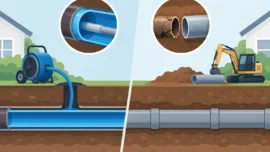
Traditional replacement often meant open trenching the full route. That is still sometimes necessary, but it is no longer the default.
For many properties, trenchless installation (often called moling) allows a new pipe to be installed under gardens, paths and driveways with only small entry and exit pits. Horizontal directional drilling (HDD) can be used where ground conditions, depth control, or longer runs require more precision.
This matters on shared supplies because the pipe route often crosses areas that are hard to reinstate neatly – shared paths, front drives, or landscaped gardens. Trenchless methods reduce the risk of arguments about who damaged what, because there is far less surface disruption in the first place.
Can you switch to separate supplies instead of keeping it shared?
Often, yes – and it is worth discussing early.
A separate supply gives each property:
- Its own stop tap and isolation
- Better clarity on responsibility
- Less risk that one property’s issue affects the other
However, it depends on what the water main can accommodate, where the new connection point can be made, and whether the route to each property is feasible without excessive disruption. In some streets, separate supplies are the best long-term solution. In others, a shared communication pipe with separate private supplies may be the practical compromise.
What a good contractor should confirm before starting
Shared water supply work is not the place for assumptions. Before works begin, you want clarity on the route, the method, and what happens if the pipe is not where you expect.
A competent contractor will normally:
- Locate the existing line as far as possible and identify likely branch points
- Confirm pipe size and propose an appropriate modern replacement
- Explain shutdown arrangements so both properties know when water will be off
- Agree reinstatement expectations for drives, flags, and landscaping
- Provide evidence of relevant approvals and insurance
For many homeowners, reassurance matters as much as the technical method. Accreditations, clear paperwork, and a workmanship guarantee reduce the risk of paying twice.
How long does it take and what disruption should you expect?
It depends on access, distance from the main, and whether you are creating separate supplies.
A straightforward replacement using trenchless moling can often be completed within a day, with water off only for the connection stages. If you need multiple connections, additional excavation at the boundary, or complex reinstatement, it can extend.
The key is planning: agree where pits will be, how spoil is managed, and how the site will be left at the end of each day. On shared access routes, a tidy site is not just nice to have – it prevents friction between neighbours and reduces trip hazards.
Costs: why quotes vary so much
Two homes on the same street can get very different prices for what sounds like the same job.
Cost is driven by the length of run, ground conditions, the number of excavations required, and how much reinstatement is needed. A shared supply under a garden is a different proposition to one under patterned block paving with steps and walls.
Also consider whether you are paying for a like-for-like replacement or upgrading to separate supplies. The upfront figure may be higher for separation, but the ongoing benefit is fewer shared liabilities.
Choosing a specialist for shared water supply pipe replacement
Because this sits at the boundary between property plumbing and external civil work, you want a contractor who does water supply installations day in, day out – not someone learning on your drive.
If you are in the North West and want a no-nonsense plan with minimal disruption, Watermains & Drains UK can assess shared supply layouts, advise on replacement versus separation, and install new pipes using trenchless methods where suitable – with recognised approvals and long-term guarantees. Details are at https://www.watermainsanddrains.co.uk.
A simple way to move forward if you share a supply
Start by treating it as a practical infrastructure upgrade, not a neighbour problem to “win”. Get the route and responsibility clear, agree how you will handle costs, and choose a method that protects the surfaces you both rely on.
The best outcome is the one you stop thinking about: turn the tap on, get steady pressure, and get on with your day.