

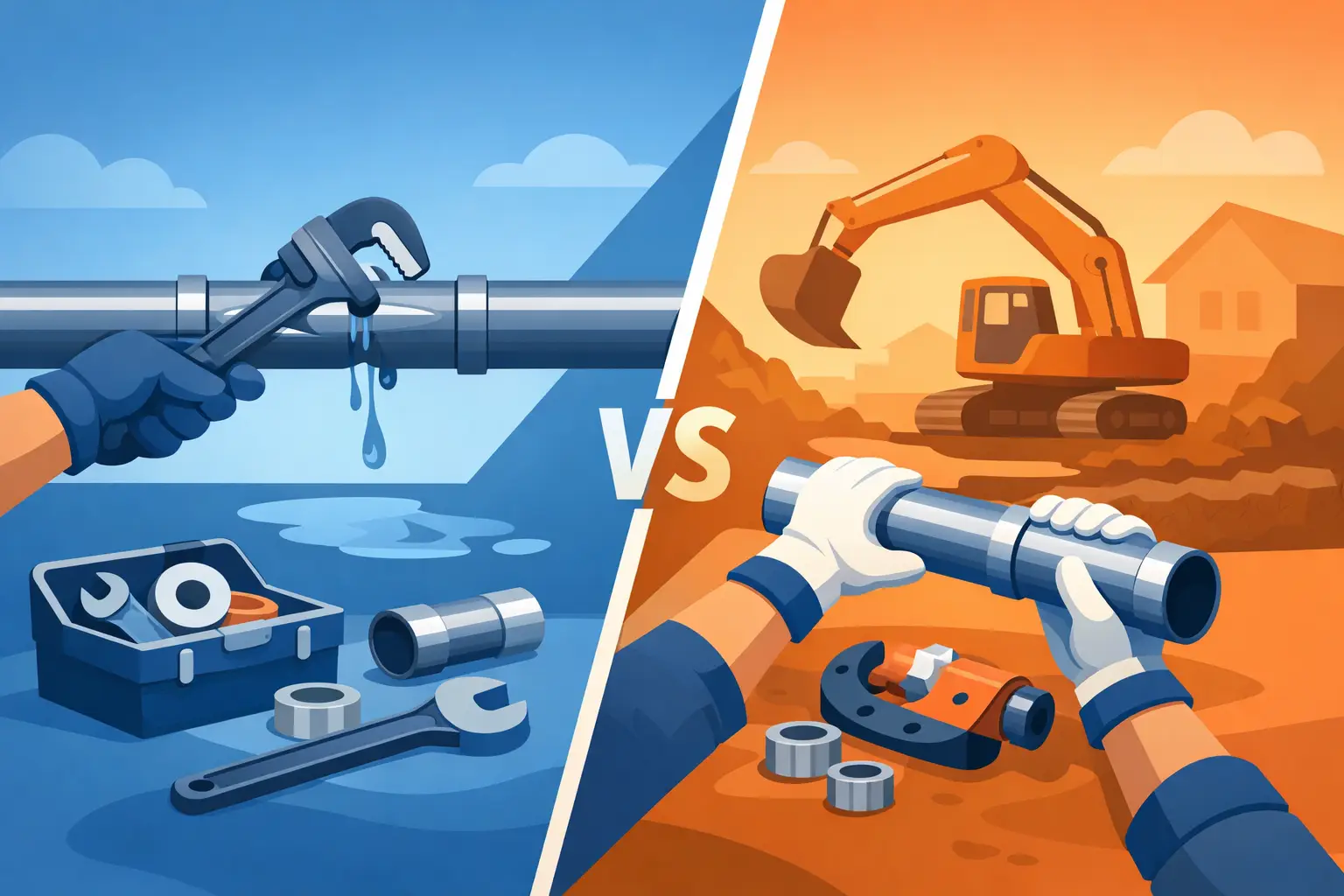
Water Pipe Repair vs Replacement: Which Wins?
A damp patch on the drive, a drop in water pressure, or a higher-than-usual bill usually leads to the same question: water pipe repair vs replacement – which is the better decision? For most property owners, the real concern is not just cost. It is how quickly the problem can be sorted, how much disruption it will cause, and whether the same fault will return six months later.
That is where a practical assessment matters. A small, localised defect can often be repaired successfully. But if the pipe is old, made from poor or outdated materials, or showing signs of wider deterioration, replacement is often the more cost-effective answer over time.
Water pipe repair vs replacement: what changes the decision?
There is no single rule that fits every property. The right option depends on the condition of the existing pipe, where the damage sits, how accessible it is, and whether the fault looks isolated or part of a bigger problem.
If a pipe has suffered one clean break caused by ground movement or accidental damage, a repair can make sense. The damaged section is identified, exposed and replaced or patched, and the rest of the line remains in service. This is often suitable where the pipe material is still in decent condition and there is no evidence of repeated leaks.
Replacement becomes more likely when the issue is not one fault but a pattern. Older supply pipes can corrode internally, crack along weak points, or suffer from poor flow because the bore has narrowed over time. In those cases, fixing one point may only delay the next call-out.
For landlords and commercial property managers, reliability is usually the deciding factor. A lower upfront repair bill can look attractive, but repeated failures create tenant disruption, access problems and added administration. A planned replacement can remove that cycle.
When a repair is usually the sensible choice
A repair is often the right route when the problem is clearly localised and the pipe still has useful life left in it. That tends to apply where the leak has been caught early and the surrounding pipework is structurally sound.
For example, if leak detection shows a single damaged section under a garden area with straightforward access, repair work can be fast and cost effective. The same applies where a relatively modern plastic supply pipe has been damaged by external pressure rather than age-related wear.
Repairs can also be suitable where budgets are tight and the pipe is otherwise performing well. That said, any short-term fix should still be honest about the risk. If the contractor suspects broader weakness, that should be made clear from the start.
A proper repair should not mean guesswork. It should start with accurate fault finding, followed by a method that restores the pipe properly rather than simply masking the issue.
Signs a repair may be enough
A repair is more likely to be worthwhile if the leak is in one identifiable spot, the pipe material is still serviceable, water pressure has generally been good, and there is no history of repeat failures. Accessibility matters too. If the defect can be reached without major excavation or reinstatement, repair becomes more attractive.
When replacement is the better long-term option
Replacement is often the stronger choice when the existing water supply pipe is at or near the end of its service life. This is common with ageing metal pipework, lead supply pipes, and older installations that no longer meet modern expectations for performance or water quality.
Lead pipework is a good example. Even if only one section is leaking, replacement is typically the better answer because the wider pipe still presents an ongoing issue. Homeowners are not only dealing with reliability, but also health concerns and the limitations of an outdated supply line.
Replacement also makes sense where pressure problems have become part of daily life. If a pipe is heavily restricted, undersized, or deteriorated along its length, patching one section will not improve the overall supply. A new pipe can solve the leak issue and improve flow at the same time.
There is also the matter of repeated excavation. If a driveway, patio or landscaped area has already been opened up once, it is worth asking whether repairing part of an old line is really the best use of money. In many cases, installing a new pipe using trenchless methods causes less disruption than people expect and avoids more digging later.
Signs replacement is likely to pay off
Replacement is usually the better investment where there are repeated leaks, the pipe is lead or badly corroded, pressure is poor across the property, or the cost of repair is high relative to the age and condition of the line. It is also worth serious consideration if access for future repairs would be difficult or expensive.
Cost is important, but so is repeat disruption
Most customers start with cost, and that is understandable. A repair is often cheaper at the point of instruction because the work area is smaller and the material cost is lower. But the cheapest first step is not always the lowest overall spend.
If the pipe fails again, you are paying twice – once for the initial repair and again for another investigation, excavation and reinstatement. That can become especially frustrating where the supply pipe runs under finished surfaces such as block paving, resin, tarmac or decorative landscaping.
Replacement has a higher upfront cost, but it often gives better value when it removes recurring faults and reduces future risk. For property managers, that predictability can be more valuable than the difference in initial price.
The right contractor should explain both sides clearly. If a repair is sensible, that should be said. If replacement is more economical over a realistic timeframe, that should be set out plainly as well.
How trenchless methods change water pipe repair vs replacement
One reason some property owners delay replacement is fear of disruption. They picture long trenches across the front garden or a drive being broken out from end to end. In some cases, traditional excavation is still needed. But modern trenchless installation has changed what is possible.
Using no-dig methods such as moling, a new water supply pipe can often be installed with minimal surface disturbance. Instead of opening a full trench, the contractor creates small launch and receive pits and installs the pipe underground. For many homes, that means less mess, quicker completion and simpler reinstatement.
This matters because the disruption gap between repair and replacement is not always as wide as people think. If a replacement can be completed cleanly and efficiently, the long-term benefits become easier to justify.
For sites with paving, gardens, access routes or busy occupied buildings, the installation method is often just as important as the repair-or-replace decision itself.
What a proper assessment should include
A decision of this kind should not be based on guesswork or a rough look at the surface. A sound assessment should consider the age and material of the pipe, the exact location of the leak, the depth and route of the line, the condition of surrounding ground, and the likely cost of reinstatement.
It should also consider performance, not just damage. If the property has poor pressure, unreliable supply or known lead pipework, those points matter even if the immediate problem appears to be one leak.
For commercial sites and managed property, the assessment should go further and account for access arrangements, tenant or operational disruption, and any compliance or documentation requirements. A specialist contractor should be able to set out a clear recommendation, a method of work and realistic timescales.
This is where using a contractor with water industry approvals and practical installation experience makes a difference. Watermains & Drains UK carries out both repair-led and full replacement work, including trenchless installations, so the recommendation can be based on what suits the site rather than a one-size-fits-all approach.
The better question is not cheapest today – it is what solves the problem properly
If the pipe is relatively modern and the damage is isolated, repair can be the right call. If the line is old, unreliable, lead, or failing in more than one way, replacement is usually the smarter choice. The best outcome is the one that restores a dependable water supply without leaving you facing the same issue again after more expense and disruption.
If you are weighing up the options, the most useful next step is a proper site-specific assessment. A clear recommendation, backed by experience and a low-disruption method, will usually tell you very quickly whether a targeted repair is enough or whether it is time to replace the pipe and move on with confidence.





