

What Is Horizontal Directional Drilling?
If you need a new water pipe under a driveway, car park, road or landscaped area, the first question is usually not about machinery. It is, “How much of this will need digging up?” That is exactly where horizontal directional drilling comes in.
HDD is a trenchless method used to install underground pipes and ducts with far less surface disruption than traditional open-cut excavation. Instead of digging a continuous trench from one end of the route to the other, contractors drill a controlled underground path, then pull the pipe back through it. For homeowners, landlords and site managers, the main benefit is simple – you get the service installed with much less damage to gardens, paving, access routes and finished surfaces.
What is horizontal directional drilling HDD?
Horizontal directional drilling, usually shortened to HDD, is a guided drilling technique for installing underground utilities without opening up the full ground surface above. It is commonly used for water supply pipes, water mains, ducts and other service crossings where excavation would be disruptive, slow or expensive.
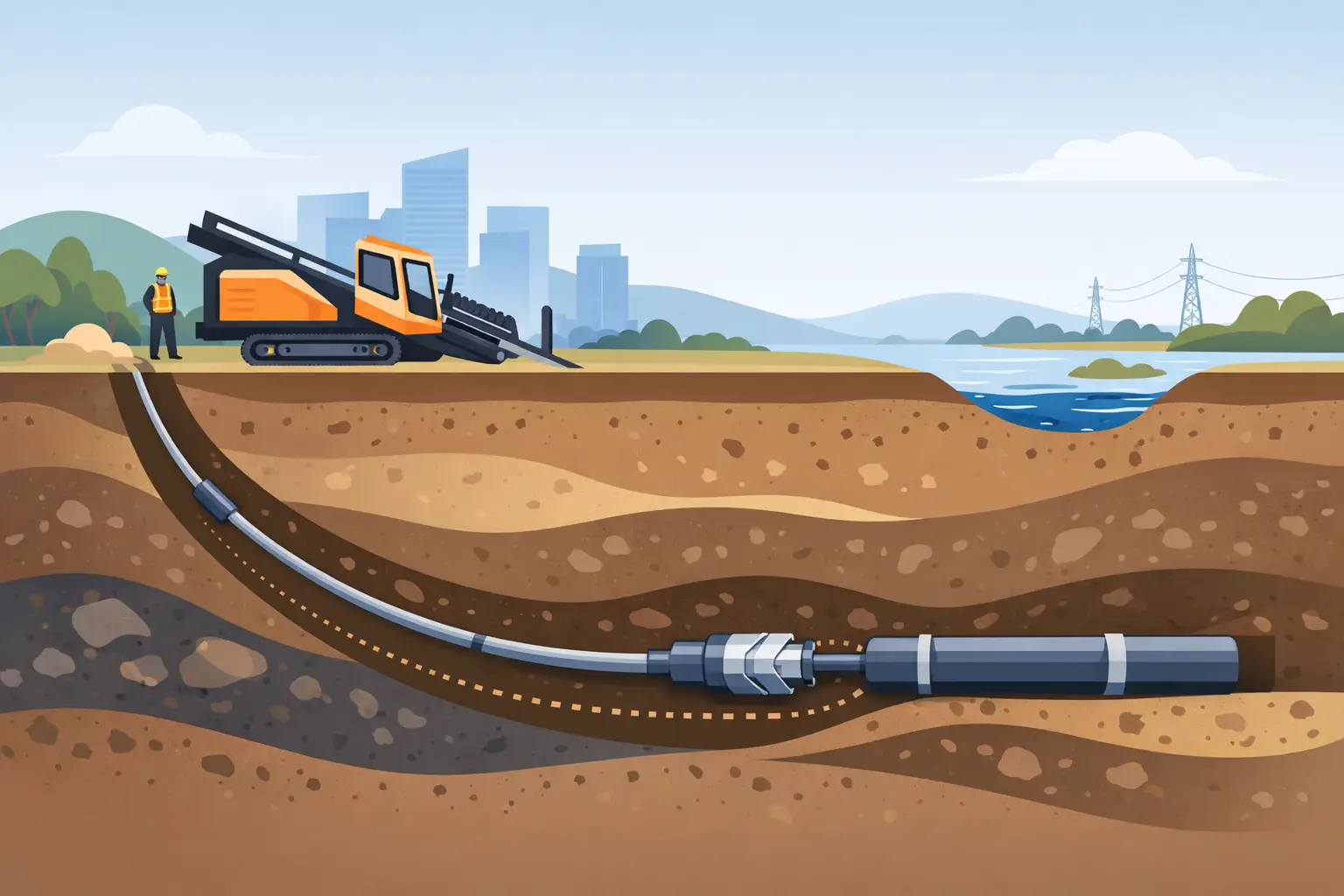
The process starts from a launch area and finishes at a reception area. Between those two points, specialist equipment drills along a planned route below the surface. Once that pilot route is complete, the hole is enlarged to suit the pipe size, and the new pipe is then pulled into place.
That basic principle sounds straightforward, but HDD is not simply “drilling sideways”. It is a controlled installation method that relies on planning, tracking and ground knowledge to keep the bore on line and at the right depth.
How horizontal directional drilling works
Most HDD projects follow three main stages.
1. Pilot bore
A drill head is launched into the ground at a shallow angle. The operator steers it along the intended route using specialist tracking equipment. This is the critical stage because it establishes the line and level for the installation.
On a water service job, that route might pass under a driveway, a garden feature, a public footpath or an access road. The aim is to reach the exit point while avoiding existing utilities and staying within the planned depth.
2. Hole enlargement
Once the pilot bore reaches the exit point, the contractor attaches a reamer to enlarge the bore. This creates enough space for the pipe to be installed safely without damaging it during pullback.
The amount of enlargement depends on the pipe type, diameter and ground conditions. Soft ground behaves very differently from mixed ground with cobbles or harder material, so this part is always planned around site conditions rather than guesswork.
3. Pullback installation
The new pipe is attached and pulled back through the prepared bore path to its final position. After that, the installation can be connected, pressure tested where required, and the entry and exit pits reinstated.
Compared with a full trench, the visible excavation is limited to the working areas at each end and any necessary intermediate access points.
Why HDD is used instead of traditional excavation
The main reason is reduced disruption, but that is only part of the picture.
If you dig a conventional trench across a finished driveway or landscaped frontage, you create spoil, noise, reinstatement work and often a longer programme. In some locations, open-cut excavation may also affect traffic management, pedestrian access or business operations. HDD avoids much of that because the surface between start and finish stays largely untouched.
For homeowners, that can mean keeping a driveway, patio or lawn intact. For commercial sites, it can mean less impact on operations, parking and public access. For landlords and facilities teams, it can reduce complaints from tenants or occupants because the job is cleaner and more contained.
That said, HDD is not automatically the right answer on every job. If the run is short, the ground is poor, access is very restricted or there are too many utility conflicts, another trenchless method or a small open excavation may be more practical. A proper site assessment matters.
Where HDD is commonly used
When people ask what is horizontal directional drilling HDD, they are often really asking when it is used. In practice, it suits any installation where preserving the surface is a priority.
Typical uses include new water supply pipe installation to homes and commercial buildings, water main crossings under roads or hard standings, duct installation, service diversions, and pipework under obstacles such as mature landscaping or entranceways.
In domestic settings, HDD is often chosen where customers do not want newly laid block paving, tarmac or decorative gardens dug out. On commercial sites, it is useful where excavation would interfere with customer access, deliveries or site safety controls.
What ground conditions mean for the job
Ground conditions affect everything – route design, drilling fluid, tooling, programme and cost.
Favourable ground can make HDD fast and efficient. Mixed or unstable ground can make it more complex. Clay, sand, made ground, cobbles and buried obstructions all behave differently, and existing services have to be identified before work starts. This is why experienced contractors do not price HDD properly from a photograph alone. They need to understand the route, the access, the installation depth and what is already in the ground.
There is also a difference between what is technically possible and what is commercially sensible. A specialist contractor may be able to complete a difficult HDD bore, but if the conditions create too much risk or too many unknowns, a different method may provide a better result.
The main benefits of HDD for property owners
For most customers, the appeal of HDD is practical rather than technical. Less excavation usually means less mess, less reinstatement and a faster route to completion.
It also reduces disturbance to finished surfaces that are expensive to put back properly. A trench through resin-bound surfacing, patterned paving or established landscaping can turn a simple utility job into a much bigger reinstatement problem. HDD helps avoid that where the site allows.
Another benefit is cleaner project management. Smaller working areas often make it easier to maintain access and keep the site tidy. That matters on occupied homes, rental properties and active commercial premises.
From a programme point of view, fewer excavations can also reduce the amount of making good required afterwards. The pipe installation may be only part of the overall cost. Rebuilding what has been dug out can sometimes cost as much attention as the utility work itself.
Limitations and trade-offs to be aware of
No-dig does not mean no excavation at all. HDD still needs launch and reception pits, safe working space and careful planning. On some sites, there may also be constraints around drilling fluid management, access for plant or the available pullback length.
There are depth and route control advantages with HDD, but there are also limits. Tight sites with many unknown services can reduce the available path. Very shallow routes may not suit the method. Equally, if the installation is small and the crossing is simple, impact moling might be the more cost-effective trenchless option.
This is where a specialist assessment adds value. The right contractor will not push HDD where a simpler method would do the job better.
HDD compared with moling
Both HDD and moling are trenchless techniques, but they are not the same.
Moling is often used for shorter, straight runs, especially for domestic water supply pipe replacement where there is a clear path between pits. It is fast, cost-effective and ideal for many front garden and driveway crossings.
HDD is generally better suited where the route needs more control, the distance is longer, the pipe size is larger, or the line needs to be guided around site constraints. In simple terms, moling is excellent for straightforward bores. HDD offers more control when the job becomes more demanding.
What to look for in an HDD contractor
Because HDD is a specialist method, the contractor matters as much as the machine. You need a team that understands underground services, route planning, reinstatement responsibilities and the standards expected on water infrastructure work.
For homeowners and landlords, look for a contractor that can explain the method clearly, assess whether HDD is genuinely appropriate, and give a straightforward quote without vague assumptions. For commercial clients, accreditations, insurance cover, programme reliability and method statements are equally important.
A specialist contractor should also think beyond the bore itself. Pipe specification, connection arrangements, pressure testing, health and safety controls, and tidy reinstatement all affect the final outcome.
At Watermains & Drains UK, HDD forms part of a wider trenchless service for water supply and drainage works, which means the installation method is matched to the property, the ground conditions and the level of disruption the customer can realistically accept.
Is HDD right for your project?
If the route passes under a surface you want to protect, HDD is often worth considering. It can be an excellent option for driveways, roads, landscaped areas and busy sites where open excavation creates too much disruption.
The key point is that HDD is not chosen because it sounds advanced. It is chosen because, on the right site, it is the cleaner, faster and more practical way to install underground pipework.
If you are weighing up a new water supply, a service diversion or a trenchless crossing, the best next step is not to guess the method. It is to get the route assessed properly, because the right underground solution usually starts with protecting what is above ground.





