Water Mains Diversion for Homes and Businesses
A planned extension, new driveway or commercial redevelopment can become far more complicated when a live water pipe runs through the proposed work area. A water mains diversion moves that pipe to a safer, compliant route, protecting both the supply and the building work around it. Done properly, it avoids future access problems, reduces the risk of damage and keeps the project moving without unnecessary excavation.
The right solution depends on whether the pipe is a water company main or a private supply pipe serving one property. That distinction affects who can approve and carry out the work, the likely programme and the costs involved. Early investigation is the simplest way to avoid designing a build around a pipe that cannot remain where it is.
When is a water mains diversion required?
A diversion is commonly needed where an existing pipe crosses the footprint of a proposed extension, garage, outbuilding or commercial development. Water pipes should not be left beneath permanent structures where future repairs would require disruptive excavation through a floor slab or foundation.
It may also be required when a driveway is being widened, a garden is being regraded, new retaining walls are planned, or a site is being redeveloped for parking, access roads or new units. Even if the pipe is not directly beneath the new structure, the proposed work may restrict safe access to it.
For homeowners, a common example is a private supply pipe running from the boundary stop tap across the front garden and directly beneath an extension. For a facilities manager, the issue may be an older service route crossing a loading area or an area being excavated for drainage, utilities or foundations. In both cases, leaving the pipe in place can create a long-term liability.
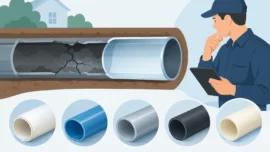
A diversion can also be the sensible option where a pipe is old, shallow, poorly routed or repeatedly damaged. Rather than carrying out reactive repairs in an unsuitable location, installing a new supply route can provide a more dependable and accessible solution.
Water company mains and private supply pipes
The phrase water main is often used for any underground water pipe, but the ownership position matters. A public main is usually owned and controlled by the local water company. If it is affected by development, the water company will normally set the diversion requirements, approve the design and arrange or authorise the work.
A private supply pipe is different. This is the pipe that carries water from the boundary connection into a home, flat, shop, office or other premises. The property owner is typically responsible for it, including leaks, upgrades and moving it away from a proposed building footprint.
A site survey and service records help establish what is present, but records are not always complete, particularly on older properties. Trial holes, careful detection and visual checks may be needed before a route is confirmed. This is why it is risky to assume that a line shown on a plan is exact, or that every pipe belongs to the water company.
Where a public asset is involved, allow more time. Formal approvals, designs, notices and water company programming can affect the overall build schedule. Where the pipe is private, the process can often be more straightforward, but the installation must still meet the required standards and be coordinated with the rest of the works.
Planning a water mains diversion before work starts
The best time to address a diversion is before foundations are marked out and before hard landscaping is installed. Once concrete, block paving, planting or internal finishes are in place, a straightforward pipe move becomes more expensive and disruptive.
A practical assessment starts with the existing supply route, the position of stop taps and meters, the proposed building lines, ground levels and other underground services. Gas, electricity, telecoms and drainage all need consideration. A new water pipe route must be safe, protected and accessible without creating conflicts with those services.
The proposed route should also account for future maintenance. Taking the shortest line is not always the best answer if it places the pipe beneath a new driveway, through a planted area that will be difficult to excavate, or close to a drainage run. A slightly longer route around the edge of the property can be a better long-term choice.
For commercial sites, diversion planning may also involve traffic management, permits, phased shut-downs and keeping tenants or customers supplied. The work needs to fit around trading hours, deliveries and site safety requirements. It depends on the premises, but a well-planned temporary supply can sometimes reduce downtime while the permanent pipework is installed.
Supply interruptions and changeovers
Most diversions require a controlled interruption while the new pipe is connected and the old section is isolated. The aim is to keep this as short as possible, with clear notice given before work begins.
Before the final connection, the new pipe should be installed, tested and prepared so that the changeover is efficient. Once the supply is restored, pressure and flow should be checked at the property. If the project involves an older lead pipe, the diversion can be an ideal opportunity to replace it with a modern approved supply pipe rather than retaining a weaker section of the system.
Choosing excavation, moling or directional drilling
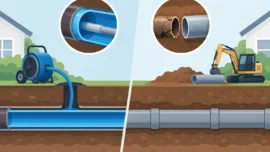
Traditional excavation remains appropriate in some situations. Open trenches provide direct access where pipework is shallow, multiple services need alteration, or ground conditions make trenchless installation unsuitable. They can also be necessary when a new connection point or valve needs to be exposed.
However, excavation is not the only option. Trenchless moling can install a new water supply beneath lawns, paths and smaller driveways with only small entry and exit excavations. This is often a fast, cost-effective option for residential properties where the aim is to avoid lifting large areas of paving or landscaping.
Horizontal directional drilling, often called HDD, is suited to longer or more complex routes, including commercial sites and routes beneath roads, car parks or hard surfaces. It gives greater control over the bore path and can be useful where depth, obstructions or ground conditions need careful management.
Neither method is automatically right for every job. A route may be unsuitable for moling if there are known obstructions, fragile surfaces, limited access or a high density of underground services. HDD may offer better control but can be more involved than a short open-trench installation. A competent contractor will recommend the method that gives the safest installation and least disruption, rather than treating no-dig work as a one-size-fits-all answer.
What good diversion work looks like
A successful diversion is not simply a new pipe in the ground. It is a properly planned installation with safe service avoidance, suitable materials, correct depth and protection, a controlled connection and tidy reinstatement. The old redundant section should be isolated where appropriate, so it cannot cause confusion during future repairs or surveys.
For homeowners, clear communication matters just as much as the technical work. You should know where the team needs access, whether water will be off, what areas may be disturbed and how surfaces will be reinstated. For property managers, the same principle extends to RAMS, scheduling, tenant communication and a clear handover record.
Using a specialist contractor also provides reassurance where a new supply connection or pipework needs to meet water-industry requirements. Watermains & Drains UK works with approved methods and modern trenchless equipment, with WIAPS and Watersafe credentials, £10m public liability cover and a 25-year workmanship guarantee on qualifying work. That combination helps protect the property owner from the cost and disruption of having to revisit the same route later.
Costs and timescales: what changes the price?
There is no meaningful fixed price for a water mains diversion because the detail of the route drives the work. A short private pipe move across a front garden is very different from diverting a pipe around an extension, beneath a driveway or across an operating commercial site.
The main factors are the length and diameter of pipe, ownership of the existing asset, access, ground conditions, the number of crossings or obstructions, the connection arrangement and the level of reinstatement required. Approval fees and water company charges may also apply where a public main is affected.
The cheapest quote is not always the lowest-cost outcome. A route that ignores future access, relies on poor reinstatement or does not properly identify existing services can create expensive problems later. A detailed survey and clear quotation give you a far stronger basis for comparing options.
If building work is approaching an existing water pipe, do not wait until the foundations are ready to find out whether it needs moving. Confirm the route early, agree the right diversion method and programme it alongside the wider project. That small piece of planning can keep a new extension, driveway or commercial site usable, supplied and far easier to maintain for years to come.