

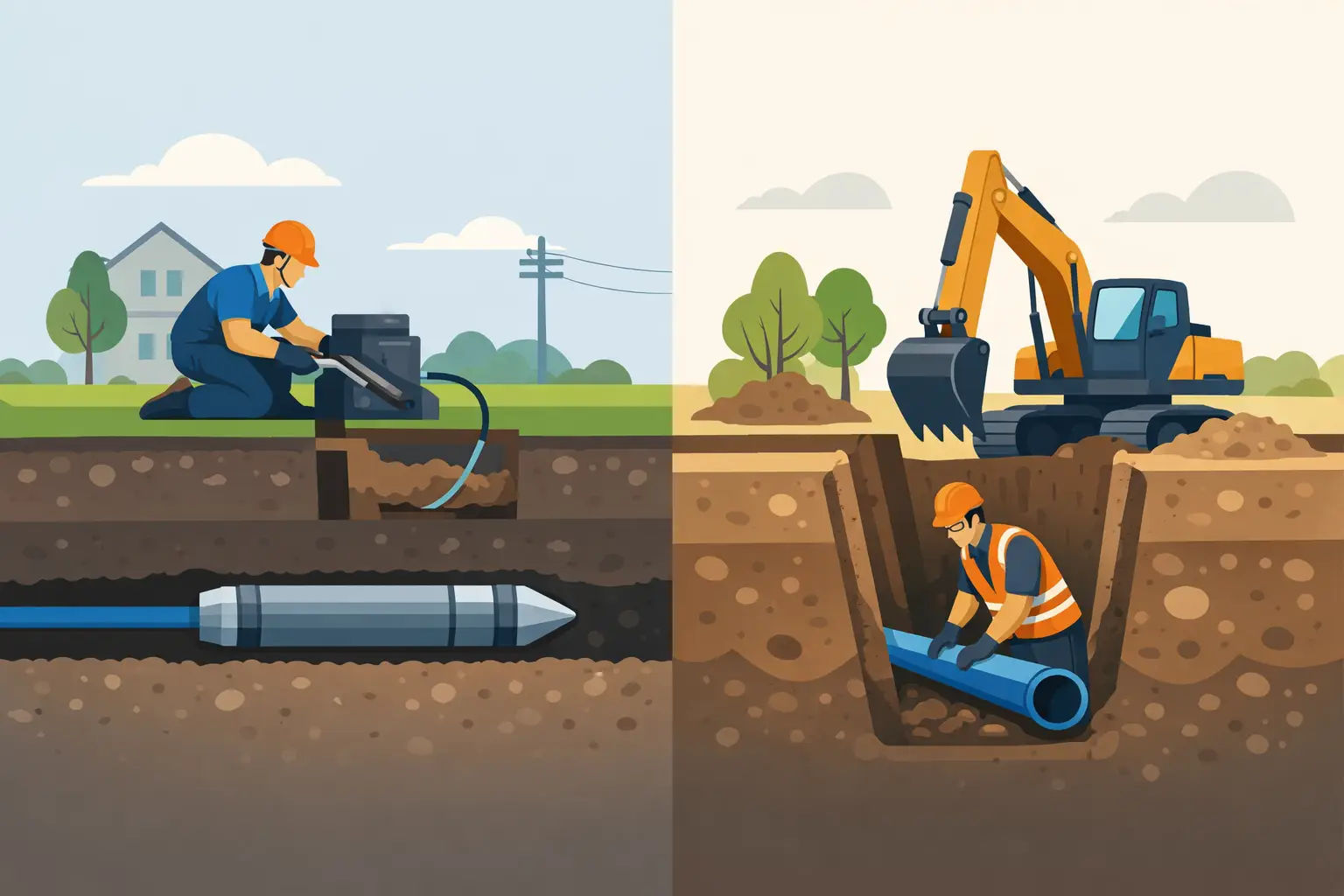
Moleing vs Trench Digging Installation
If you need a new water supply pipe or a damaged pipe replaced, the method matters almost as much as the pipe itself. When comparing moling vs trench digging installation, most property owners are really asking a practical question: which option gets the job done properly, with the least mess, delay and reinstatement cost?
That is the right question to ask. The cheapest quote on day one is not always the cheapest job by the time a driveway, patio, lawn or internal flooring has been put back. The best installation method depends on access, ground conditions, depth, existing services and how sensitive the surrounding area is to excavation.
Moling vs trench digging installation: the basic difference
Trench digging installation is the traditional open-cut method. A trench is excavated along the route of the new pipe, the old service is exposed or removed where needed, the new pipe is laid, and the ground is reinstated afterwards. It is straightforward, widely understood, and in some situations it is still the correct approach.
Moling is a trenchless method. Instead of opening the full route, the contractor excavates small launch and reception pits and uses a pneumatic mole to create a bore underground. The new pipe is then pulled through beneath the surface. For many domestic water supply replacements, this avoids digging across gardens, paths and driveways.
For homeowners, the appeal is obvious. Less excavation usually means less disruption, faster completion and less reinstatement. For landlords and commercial sites, it can also reduce disturbance to tenants, customers and day-to-day operations.
Where moling usually has the advantage
Moling is often the preferred option for replacing or installing a water supply pipe from the boundary to the property, especially where the route passes under finished surfaces. A paved driveway, established lawn, decorative landscaping or a path that would be costly to break out and rebuild can make trenchless work the more sensible choice.
It is also useful where access needs to be kept practical during the works. If a full trench across the front garden and drive would affect parking, pedestrian access or general site use, moling can keep the disruption contained to a couple of excavation points.
Speed is another reason it is popular. On suitable ground, trenchless installation can be completed far more quickly than full open-cut excavation. That can reduce labour time and it often shortens the period that the site looks like a work zone.
This is one reason specialist contractors increasingly recommend no-dig methods for domestic supply upgrades, particularly lead pipe replacement. If the old lead supply needs to be abandoned and a new MDPE pipe installed, moling can provide a clean route without tearing through the whole frontage.
The practical benefits of moling
The strongest argument for moling is not that it is always cheaper on paper. It is that the overall job can make more financial sense once reinstatement is considered. Breaking out concrete, lifting block paving, removing shrubs and then rebuilding everything neatly can add time and cost quickly.
A trenchless route often means less spoil to remove, fewer materials to reinstate and less visible evidence that work has taken place. For occupied homes, that usually matters as much as the installation cost itself.
When trench digging is still the right answer
There are plenty of jobs where open trench excavation is the better method. If the pipe route is short, clear and running through soft ground with no expensive surfaces above, trenching can be perfectly efficient. In some cases it may be the most direct and cost-effective option.
Ground conditions are a major factor. Moling works best in suitable soil, but it is not ideal in every ground type. Very rocky ground, heavy obstructions, made-up ground with debris, or uncertain conditions can make accuracy and progress more difficult. If the route is congested with unknown services or old structures, exposing the line through careful excavation may be safer.
Trenching is also useful where the contractor needs full visibility of the pipe run. If there are several existing services, changes in depth, complex connections or repairs to other assets at the same time, open excavation gives complete access.
Why some sites need open excavation
If the job involves more than simply installing a new supply pipe, trenching may be necessary. For example, if drainage runs need repair, if inspection chambers require adjustment, or if the route includes sections that must be visually confirmed for compliance, excavation can give better control.
On some commercial and shared-access sites, method selection is not only about speed. It is about risk management, service avoidance and clear installation records. In those cases, the visibility of a trench can support the wider scope of works.
Cost: the real comparison
People often expect moling to be the premium option and trench digging to be the budget option. Sometimes that is true, but not always.
If you only compare the installation activity itself, trenching can appear cheaper on a simple site. But the full cost includes excavation, spoil removal, making good, surface reinstatement, waste handling and the extra time on site. Once those items are added, moling can compare very well.
The reverse is also true. If the ground is unsuitable for moling, or if extra pits and specialist planning are needed because of buried services and awkward access, trenching may come out better value.
That is why proper site assessment matters. A serious contractor should not push one method for every job. They should look at the route, identify likely obstructions, consider the surface finishes and then recommend the option that gives the best overall result.
Disruption, access and reinstatement
For most homeowners, this is where the decision is made.
A trench through a drive or front garden is more intrusive. There is no point pretending otherwise. Even with tidy working practices and good reinstatement, open excavation creates a larger work area, more spoil and more visible disturbance while the job is underway.
Moling keeps the footprint smaller. That can be particularly helpful on narrow plots, properties with limited parking, or homes where access needs to be maintained as far as possible. It also reduces the amount of reinstatement that needs to be colour-matched, levelled and finished to blend with the existing surface.
This matters even more on decorative block paving, printed concrete, resin-bound finishes and landscaped gardens. Reinstatement can be done well, but many customers would rather avoid disturbing those surfaces in the first place.
Compliance and workmanship still come first
The least disruptive method is only the right choice if it is carried out correctly. Water supply installations need to meet the required standards for materials, depth, routing and connection. That is why experience and accreditation matter.
For property owners, this is not just a technical detail. It affects whether the new supply will be accepted, whether the work is future-proof, and whether there is confidence in the result long after the ground is closed up.
Specialist contractors should be able to explain the method clearly, quote for the full scope including reinstatement, and carry out the work with proper insurance and workmanship guarantees in place. That gives reassurance whether the site is a house, rental property or commercial premises.
How to choose between moling and trench digging
The sensible way to decide is to start with the site, not the preference. Ask what lies above the pipe route, what is below it, how much access is available, and what level of disruption is acceptable.
If the route crosses expensive surfaces and the ground is suitable, moling is often the stronger option. If the ground is uncertain, the route is heavily obstructed, or the works require full exposure and access, trench digging may be the better call.
In practice, some jobs use both. A contractor may trench a short section where visibility or connection access is needed and mole the longer section beneath a driveway or garden. That kind of mixed approach often delivers the best balance of control and minimal disruption.
At Watermains & Drains UK, that is usually the point of the conversation with customers across the North West. Not which method sounds better in theory, but which one solves the problem properly, quickly and with the least avoidable mess.
If you are weighing up moling vs trench digging installation, the right answer is rarely about trends or sales talk. It comes down to ground conditions, reinstatement sensitivity and getting a compliant new pipe in place without creating unnecessary work around it. A good contractor will tell you when no-dig is the smart option, and when a trench is simply the honest choice.





