Who Is Responsible for Water Supply Pipe?
A sudden drop in water pressure, a wet patch on the drive, or a leak that seems to appear from nowhere usually leads to the same question: who is responsible for water supply pipe issues? In the UK, the answer depends on exactly where the pipe sits, where the boundary of the property falls, and whether the problem is on the public network or the private supply serving your building.
Getting that distinction right matters. It affects who pays for repairs, who you need to contact first, and how quickly the issue can be resolved without unnecessary digging or delay.
Who is responsible for water supply pipe in the UK?
In simple terms, the water company is usually responsible for the public water main in the street and, in many cases, the communication pipe up to the property boundary. The property owner is usually responsible for the supply pipe running from that boundary into the home or building.
That sounds straightforward, but on site it is not always quite that neat. Older properties, shared supplies, flats, and mixed-use premises can blur the line. The age of the pipework also matters, especially where lead pipes or undocumented alterations are involved.
For most homeowners, the practical rule is this: if the leak or damaged pipe is within your boundary and supplies only your property, responsibility is likely to sit with you. If it is in the public highway or on the water company’s side of the boundary, it is more likely to be theirs.
Understanding the difference between a water main, communication pipe and supply pipe
The easiest way to avoid confusion is to separate the pipework into three parts.
The water main is the public pipe in the road or footpath that supplies multiple properties. This belongs to the water company.
The communication pipe is the section that runs from the main to the boundary of an individual property. In many standard domestic arrangements, this is also the water company’s responsibility.
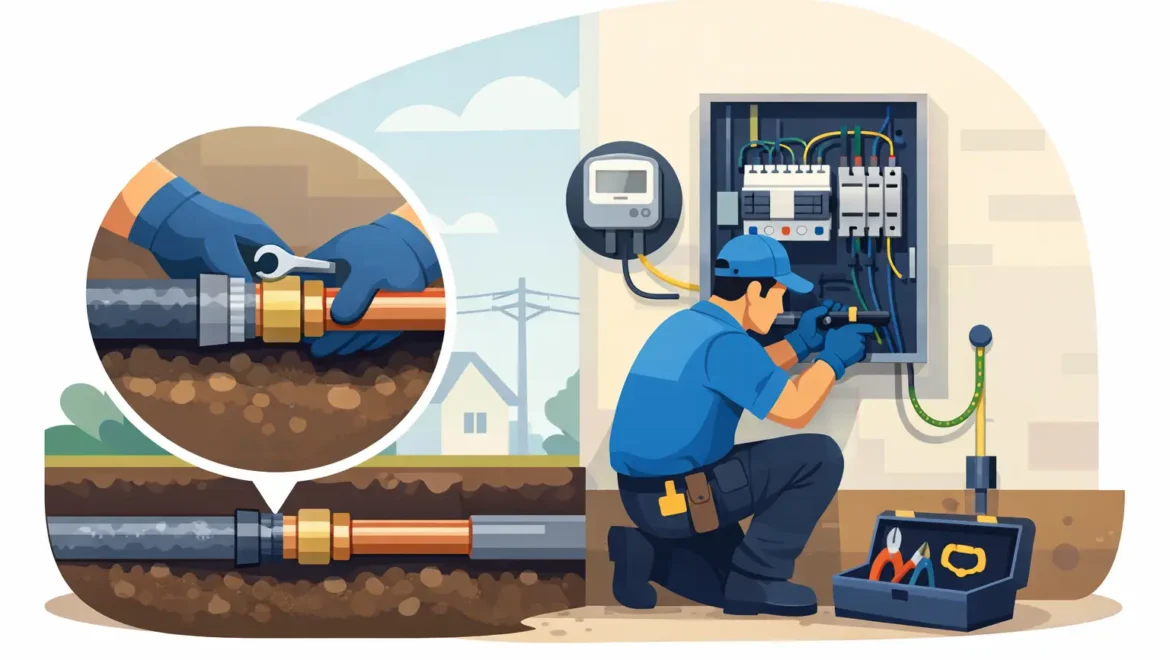
The supply pipe is the private pipe running from the boundary into the property, often ending where it enters the building or connects to the internal stop tap. This section is usually the owner’s responsibility.
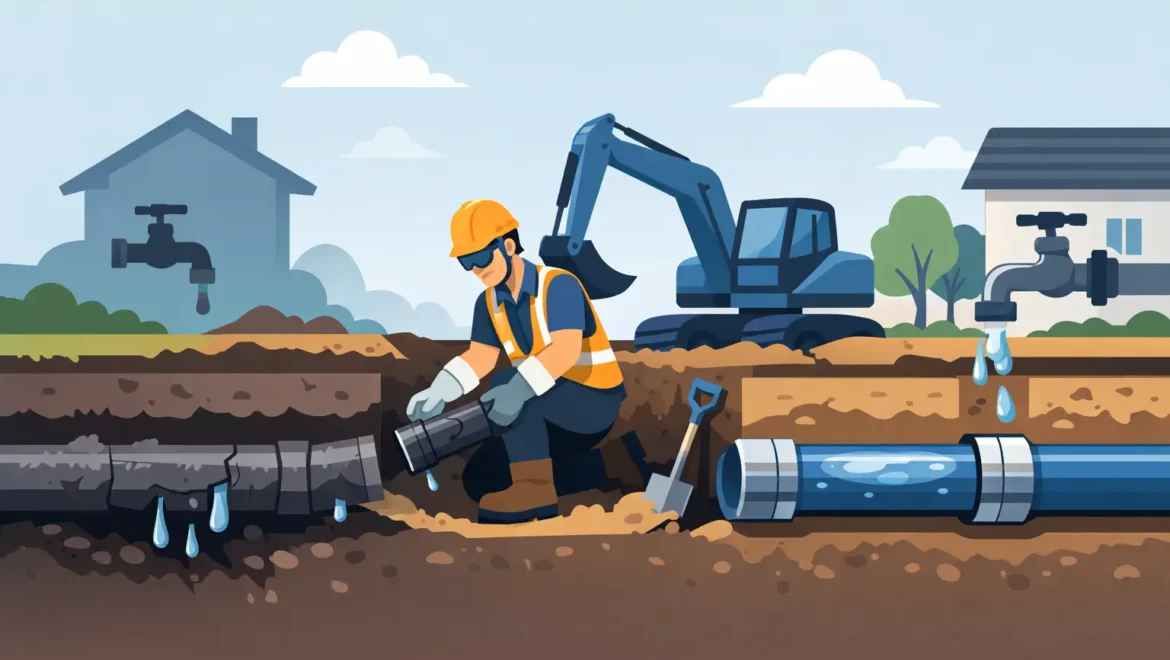
If you are trying to locate a leak, that division is critical. A burst under the pavement outside your boundary may need reporting to the utility provider. A leak beneath your garden, driveway or floor slab is more likely to be a private repair.
Where the boundary line changes responsibility
The boundary is often the key point, but it is not always obvious on older sites. In a typical house, the responsibility changes at the external boundary of the property, not necessarily at the meter chamber or internal stop tap.
If your external stop tap or meter is in the pavement, that does not automatically mean every pipe beyond it is public. Likewise, a leak in the verge outside the front wall is not automatically your problem. The location of the legal boundary and the layout of the incoming service both need checking.
For landlords and property managers, this is where early investigation saves time. Assumptions can lead to the wrong contractor being called or delays while each party tries to establish liability.
Who pays for repairs to a private water supply pipe?
If the damaged section is your private supply pipe, the repair cost usually falls to the homeowner, landlord, freeholder or site owner. That includes excavation, pipe replacement, leak repair, reinstatement and any related work needed to restore the area.
For domestic owners, this can come as a surprise, especially when the leak is outside the house. People often assume the water company covers anything before the internal plumbing starts. In reality, private external pipework is commonly the owner’s responsibility.
There can also be knock-on costs. A leaking supply pipe may cause water loss, reduced pressure, ground movement, damage to paving, or problems with contaminated or ageing pipe materials such as lead. If the pipe is old, a repair may not be the best long-term answer. Full replacement is often more cost effective than repeated patch repairs.
Shared supply pipes and older properties
Shared supply arrangements are where things become less clear. On some older streets, one pipe enters a group of properties and then branches off underground. In that case, several owners may share responsibility for the private section.
That can be awkward if a leak is affecting multiple homes but sits beneath one garden or driveway. Responsibility may be shared even if the visible damage appears in one place. It depends on the layout of the pipe and who benefits from that section of supply.
This is common in older terraces and properties that have been altered over time. Lead supply pipes are also more likely in these settings, which brings an added reason to replace rather than repair. If a shared lead pipe is still serving more than one property, it is worth getting the arrangement assessed properly before any work starts.
Flats, commercial sites and tenanted buildings
For flats and larger commercial properties, responsibility often depends on ownership structure. In a block of flats, the freeholder or management company may be responsible for the incoming private supply pipe, while internal plumbing within each unit may fall elsewhere.
In rented houses, the tenant is not usually responsible for repairing the external water supply pipe unless the tenancy agreement clearly says otherwise and that clause is enforceable. In most cases, the landlord deals with it.
For commercial premises, facilities teams often need more than a simple answer about liability. They need a contractor who can identify the fault, work safely around occupied sites, provide clear records, and complete reinstatement neatly. That is particularly important where access roads, customer car parks or paved yards are involved.
What to do if you are not sure who is responsible
If you do not know whether the leak is on the public side or your private side, start by identifying the approximate location of the fault. Visible water, poor pressure, an unexpected rise in consumption, or noise on the line can all point to a buried leak, but the exact break point still needs tracing.
Your water company may confirm whether they are responsible for the public main or communication pipe. If the issue appears to be on private pipework, a specialist contractor can investigate the route of the supply, detect the leak and advise whether repair or replacement is the better option.
This matters because the cheapest first step is not always the cheapest overall. Excavating trial holes across a driveway or garden can quickly become more disruptive and expensive than a planned trenchless installation. Modern no-dig methods such as moling often allow a new supply pipe to be installed with far less disturbance to paths, lawns and hardstanding.
Why pipe location is only part of the decision
Even when responsibility is clear, the right solution still depends on the condition of the pipe, the surface above it, and the age of the installation.
A small leak on a modern plastic supply may be repaired locally if the rest of the line is sound. A leak on an ageing lead or corroded metal pipe is different. In that case, replacement is usually the more sensible route. It reduces the chance of future leaks, can improve flow and pressure, and avoids spending money on a pipe that is already near the end of its serviceable life.
This is especially relevant for homeowners planning renovations, landlords managing older stock, and commercial sites that cannot afford repeat call-outs. A tidy permanent solution is often better than a quick fix that fails again six months later.
Who is responsible for water supply pipe if it is leaking under a driveway or garden?
If the leaking water supply pipe is within your property boundary, you are usually responsible even if it sits under a driveway, garden, patio or outbuilding access. The surface above the pipe does not change ownership of the pipe below it.
What it does change is the repair approach. Excavating through block paving, tarmac or landscaped gardens can be disruptive if handled badly. That is why specialist contractors use methods designed to keep openings small and reinstatement neat. For many properties, replacing the whole private supply with minimal excavation is faster and cleaner than chasing a leak with multiple open trenches.
For property owners in the North West, that practical side of the job often matters just as much as the legal answer. Knowing who pays is one thing. Getting it fixed quickly, safely and with the least disruption is what really solves the problem.
The simplest way to approach it
If the issue is on the public main or communication pipe, report it to the water company. If it is on your private supply pipe, arrange for a specialist contractor to investigate and quote. If you are unsure, get the pipe route and leak location checked before making assumptions.
That approach avoids delays, avoids unnecessary excavation, and gives you a clear path to a proper repair or replacement. Firms such as Watermains & Drains UK are often called in at that stage because the job is not just about finding the fault – it is about resolving it with the least disruption and a standard of work that stands up over time.
A leaking supply pipe rarely improves by waiting, and responsibility is much easier to manage once the pipe has been correctly identified.